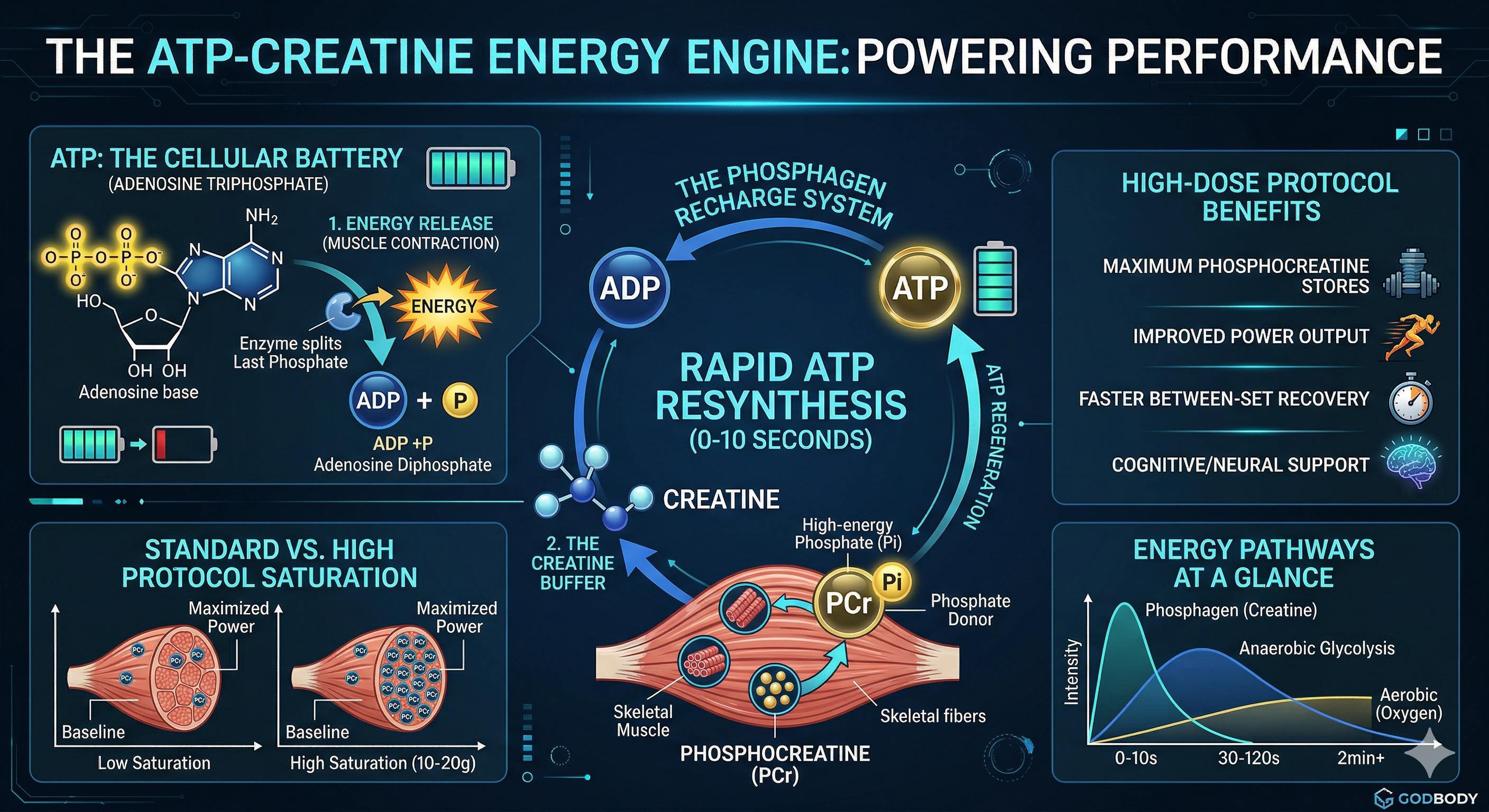
Creatine is not just a supplement; it is a fundamental cellular fuel. While the old-school “5g a day” recommendation was designed to prevent deficiency, modern high-performance protocols are pushing the boundaries of muscle saturation and neurological recovery.
The Classification & ADME
- The Identity: A nitrogenous organic acid (alpha -methylguanidinoacetic acid) synthesized from Arginine, Glycine, and Methionine.
- Absorption: Near 100% bioavailability. Peak plasma levels occur 60–120 minutes post-ingestion.
- Distribution: Driven into cells via the CreaT1 transporter.
- Metabolism: Non-enzymatic conversion into Creatinine (excreted via kidneys).
- Half-Life: The plasma half-life is ~3 hours, but the biological half-life (how long it stays in the muscle) is weeks. This is why missing one day isn’t a “fail,” but consistency is king.
The New Era of Dosing: Beyond the 5g Ceiling
The “5g/day” rule was based on a 70kg (154lb) individual. For the God Body athlete—larger, leaner, and training with higher volume—higher dosages ensure the “tank” is always overflowing.
The High-Yield Protocol
- The Saturation Phase (The Loading Blitz): 20g–30g per day, split into 5g doses, for 5–7 days.
- The Performance Maintenance: 10g–15g per day.
- Why? Larger athletes with high muscle mass turnover creatine faster. 10g–20g daily ensures maximum phosphocreatine (PCr) stores are maintained even under extreme CNS and physical stress.
Timing: Does It Matter?
- Pre-Workout: Purely for habit. It has no acute “stimulant” effect.
- Intra-Workout: Excellent for hydration. Pairing with electrolytes helps the sodium-dependent transport.
- Post-Workout (The Winner): Peak insulin sensitivity post-training makes this the optimal window for uptake.
- The Verdict: While total daily intake is the priority, Post-Workout remains the gold standard for efficiency.
The Multi-System Effects
Physical & Performance
- Rapid ATP Resynthesis: Faster recovery between sets of 1–5 reps.
- Cellular Swelling: Intracellular hydration triggers myogenic signaling pathways (mTOR).
- Myostatin Inhibition: Some evidence suggests creatine may lower myostatin, potentially raising the ceiling for muscle growth.
Cognitive & Mental Acuity
- The “Brain Buffer”: The brain uses 20% of the body’s energy. High-dose creatine reduces mental fatigue during high-stress periods or sleep deprivation.
- Neuroprotection: Aids in maintaining cellular integrity against oxidative stress.
Synergy: The Force Multipliers
To maximize a 10g–20g dose, you need the right “keys” to open the cell doors:
- Insulin (Carbs): High-glycemic carbs (30g–50g) spike insulin, which activates the sodium-potassium pump, pulling creatine into the muscle.
- Sodium: Creatine transport is sodium-dependent. If you are salt-depleted, you are wasting your creatine.
- Beta-Alanine: While creatine handles the 0–10 second energy window, Beta-Alanine handles the 30–60 second window. Together, they cover the entire set duration.
Safety, Restrictions & Side Effects
- Who Should Avoid It? Those with pre-existing, clinical renal disease (Stage 3+).
- The “Bloat” Myth: Most “bloat” is actually intracellular water (inside the muscle), which is exactly what we want. Subcutaneous (under skin) water usually comes from poor diet or low-quality, impure creatine.
- Side Effects: At 20g servings, GI distress (cramping/diarrhea) can occur if not taken with enough water.
- Pro Tip: If taking 20g, split it into two 10g doses or ensure you’re drinking 500ml of water per 5g of powder.
THE CURRENCY OF POWER: ATP AND THE PHOSPHAGEN PATHWAY
To understand why we are pushing 10g–20g of Creatine, we have to look at the molecule that literally powers every heartbeat, every blink, and every 405lb squat: Adenosine Triphosphate (ATP).
What is ATP? (The Biological Battery)
Think of ATP as the “universal currency” of the body. Your muscles cannot “burn” chicken, rice, or even pure glucose directly. All those fuels must be converted into ATP before the muscle fibers can contraction.
- The Structure: One molecule of Adenosine bound to three Phosphate groups.
- The Energy Release: The “magic” happens in the chemical bonds between those phosphates. They are high-energy bonds, but they are unstable.
- The “Explosion”: When your brain signals a muscle to contract, an enzyme breaks off the third phosphate group. This release of energy powers the contraction.
- The Result: You are left with ADP (Adenosine Diphosphate)—a “dead battery” with only two phosphates.
The Energy Pathways: How You Refuel
Your body has three main systems to recharge that ADP back into ATP. Think of them as different gears in a car:
1. The Phosphagen System (The Nitrous Oxide)
- Duration: 0–10 seconds.
- Intensity: Maximum (Sprints, 1RM, heavy triples).
- The Mechanic: This is where Creatine lives. When you run out of ATP (which happens in about 2 seconds), your body looks for a spare phosphate to stick back onto the ADP.
- The Advantage: By supplementing with high-dose Creatine, you increase your stores of Phosphocreatine (PCr). You essentially have a massive warehouse of spare “parts” to rebuild ATP instantly, allowing you to maintain peak power for 3–4 seconds longer than your competition.
2. Anaerobic Glycolysis (The Turbo)
- Duration: 30 seconds – 2 minutes.
- Intensity: High (Hypertrophy sets of 8–12, 400m dash).
- The Fuel: Glucose (Sugar) from your blood or Glycogen from your muscles.
- The Trade-off: It’s fast, but it produces Lactic Acid and Hydrogen ions, which cause that “burning” sensation and eventual failure.
3. Aerobic/Oxidative System (The Cruiser)
- Duration: 2 minutes to hours.
- Intensity: Low to Moderate (Walking, steady-state cardio).
- The Fuel: A mix of Carbohydrates and Fats. It requires Oxygen to work. It’s highly efficient but too slow for explosive growth.
The Science of the “Fail”: Why You Stop
When you’re grinding out that 10th rep and the bar stops moving, it’s not because your muscle “gave up”—it’s because the rate of ATP resynthesis could no longer keep up with the rate of ATP demand.
Your “battery” is dead, and the Phosphagen system (Creatine) is empty.
Why 10g–20g Changes the Game
Standard 5g doses keep your “tank” at a baseline level. However, during high-volume, high-intensity training, you are burning through PCr faster than a standard dose can replenish. By utilizing a High-Saturation Protocol (10g–20g), you are ensuring:
- Maximum Buffer: More “spare phosphates” available at the start of every set.
- Faster Recapture: Between sets, your body can pull from the high systemic levels of creatine to reload the muscle cells faster.
- CNS Support: The brain uses the Phosphagen system to maintain focus and “drive” during heavy lifting. More creatine = less neural fatigue.
Summary: The ATP Loop
- ATP loses a phosphate to create Energy.
- ADP (the leftover) is useless on its own.
- Creatine (Phosphocreatine) donates its phosphate to ADP.
- ATP is reborn, and you get two more reps.