Somatropin (HGH) is a peptide hormone that stimulates growth, cell reproduction, and regeneration. Unlike anabolic steroids which primarily drive hypertrophy (growth of existing cells), HGH is prized for its potential role in hyperplasia—the creation of new muscle cells. This is the “God Tier” of pharmacology when applied correctly.
The Basics: Somatropin and IGF-1
HGH is produced by the pituitary gland. When administered exogenously, it travels to the liver where it stimulates the production of IGF-1 (Insulin-like Growth Factor 1).
- The Mechanism: HGH is highly lipolytic (fat burning), while its metabolite, IGF-1, is highly anabolic (muscle building).
- Synergy: HGH is notoriously “weak” when used alone for muscle mass. Its true power is unlocked when combined with a Testosterone base and, for advanced users, Insulin.
ADME: Absorption, Distribution, Metabolism, and Excretion
- Absorption: Most effective via Subcutaneous (Sub-Q) injection into adipose tissue.
- Bioavailability: Roughly 70-90%.
- Half-Life (t1/2): Extremely short—about 30 minutes. However, the resulting IGF-1 elevation lasts for approximately 20-24 hours.
- Dosing Frequency: Because HGH mimics the body’s natural pulses, daily administration is standard. Many prefer “5 days on, 2 days off” to manage cost and sensitivity, though daily use is superior for stability.
Advantages & What Dosage Actually Works
The biggest mistake in HGH use is “under-dosing” for the intended goal.
| Goal | Dosage (IU per Day) | The Reality |
| Anti-Aging / Wellness | 1 – 2iu | Improved skin, hair, sleep, and recovery. No significant muscle gain or fat loss. |
| Fat Loss / Metabolism | 3 – 4iu | The “Sweet Spot.” Dramatic lipolysis (fat burning) becomes evident after 8-12 weeks. |
| Hypertrophy (Muscle) | 5 – 8iu | The “Pro” range. At this level, HGH significantly aids in new tissue growth but requires exogenous insulin management. |
The Timeline: HGH is not a “6-week cycle” drug. You do not see the architectural changes to the physique until the 6-month mark.
Female Usage: The Fountain of Youth
HGH is arguably the most “female-friendly” performance enhancer in existence.
- No Virilization: Zero risk of voice deepening or hair growth.
- Fat Distribution: Highly effective at targeting stubborn female fat patterns (hips/thighs).
- Dosing for Women: 1 – 2iu is typically sufficient for significant cosmetic improvements and recovery.
Side Effects & Management
HGH is safe but has “growth-related” side effects that must be monitored:
- Insulin Resistance: HGH can decrease insulin sensitivity, leading to elevated blood glucose. Chronic high-dose use can lead to Type 2 Diabetes.
- Edema (Water Retention): Commonly felt as “tightness” in the hands and ankles. Usually tapers off after the first month.
- Carpal Tunnel Syndrome: Growth of the connective tissue around the wrist can compress nerves. This is often a sign the dose is too high.
- Organ & Bone Growth: In extreme, high-dose abuse (Acromegaly), internal organs and facial bones can grow.
Who is it Good For?
- The Veteran Athlete: Who has hit a plateau and needs to shift their “genetic ceiling” via hyperplasia.
- The Injury-Prone: Those with chronic tendon or ligament issues (HGH significantly speeds up collagen repair).
- The “Lifestyle” Optimizer: Individuals over 40 looking to maintain a youthful metabolic rate and skin elasticity.
Monitoring and Blood Work
- IGF-1 Levels: This is the primary marker to ensure your HGH is “real” and to see how your body is responding.
- HbA1c / Fasting Glucose: Non-negotiable. You must monitor your blood sugar to ensure the HGH isn’t inducing pre-diabetes.
- Thyroid (T3/T4): Chronic HGH use can suppress thyroid function; many users supplement with low-dose T3 (25mcg)
Dosing Strategies & Timing: The Bio-Hacker’s Protocol
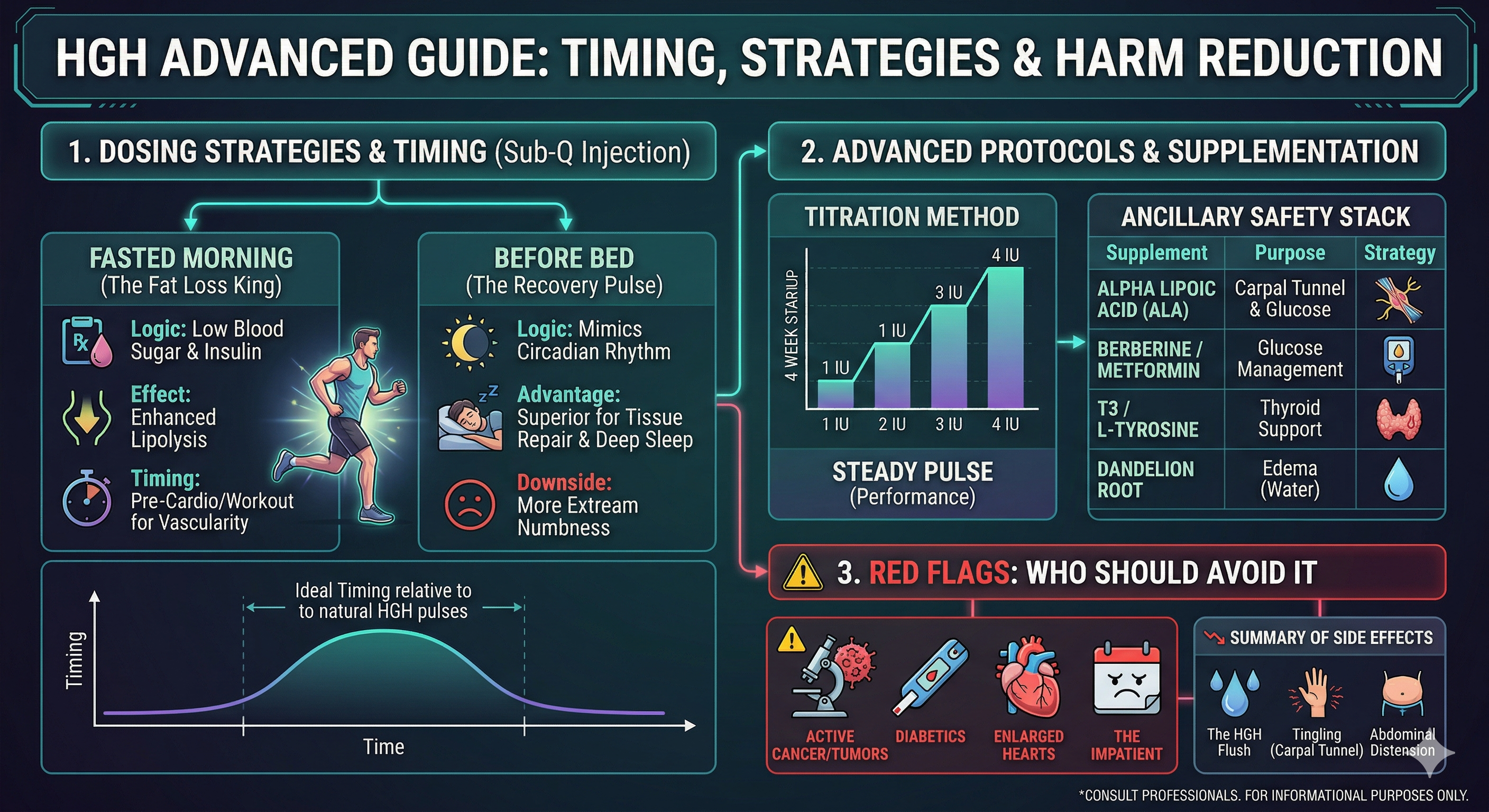
HGH administration is not just about how much, but when. Because exogenous HGH suppresses your natural nighttime “pulse,” timing dictates the pharmacological effect.
1. Fasted Morning (The Fat-Loss King)
- The Logic: Blood sugar and insulin are at their lowest in the morning. Since insulin is the direct antagonist to HGH, injecting fasted allows for maximum lipolysis (fat mobilization).
- Pre-Cardio/Workout: Administering 30–60 minutes before training increases Free Fatty Acid (FFA) mobilization.
- The Result: Enhanced vascularity and a “dryer” look as the body prioritizes fat as a fuel source during the session.
2. Before Bed (The Recovery Pulse)
- The Logic: Mimics the body’s natural circadian rhythm of growth hormone release.
- The Advantage: Superior for deep sleep quality and tissue repair (tendons/ligaments).
- The Downside: Can lead to higher morning blood glucose levels (Dawn Phenomenon) and more significant “numbness” in the extremities.
Titration vs. Steady Pulse Dosing
How you introduce HGH to your system determines how many side effects you suffer.
- The Titration Method (Recommended): Start at 1.0–2.0 IU daily for the first 2–4 weeks. Increase by 0.5–1.0 IU every 2 weeks until you reach your target dose.
- Why: This allows the body to adjust to the sodium/water retention, preventing severe edema and “moon face.”
- Steady Pulse (The Performance Approach): Maintaining a flat dose (e.g., 4 IU daily) for 6+ months.
- Advanced “Blast” Dosing: Some athletes use high doses (10+ IU) post-workout only on training days to maximize the IGF-1 response, though this carries a much higher risk of insulin resistance.
Ancillary Supplementation: The Safety Stack
Running HGH without these supports is a recipe for carpal tunnel and metabolic syndrome.
| Supplement | Purpose | Recommended Strategy |
| Alpha Lipoic Acid (ALA) | Carpal Tunnel & Glucose | 600 – 1200 mg daily. ALA is a potent antioxidant that improves insulin sensitivity and reduces the nerve inflammation that causes HGH-induced numbness. |
| Berberine / Metformin | Glucose Management | Helps counteract HGH-induced insulin resistance. Keeps fasting blood sugar in the “healthy” range 100 mg/dL. |
| L-Tyrosine / T3 | Thyroid Support | HGH speeds up the conversion of T4 to T3, which can eventually deplete your thyroid. Low-dose T3 25mcg keeps the metabolism firing. |
| Dandelion Root | Edema (Water) | A natural diuretic to help “flush” the initial water retention seen in the ankles and wrists. |
Who Should Avoid HGH? (The Red Flags)
HGH is a “pro-growth” agent. It does not distinguish between healthy tissue and pathology.
- Active Cancer/Tumors: If a malignancy exists, HGH will act as high-octane fuel for it. Cancer screening is a prerequisite for HGH use.
- Diabetics: Unless under strict medical supervision, the impact on blood glucose makes HGH extremely dangerous for those with compromised insulin production.
- Individuals with Enlarged Hearts: HGH can contribute to ventricular hypertrophy.
- The Impatient: If you aren’t committed to a 6-month minimum run, you are wasting money. The benefits are cumulative, not immediate.
Summary of Side Effects
- The “HGH Flush”: A temporary feeling of warmth or redness after injection.
- The “Numbness”: Tingling in the fingers (Carpal Tunnel) is a sign of water retention around the nerves. Reduce the dose or increase ALA.
- Abdominal Distension: Often called “GH Gut.” This is typically only seen in extreme doses (8+ IU) combined with high-calorie diets and insulin abuse.