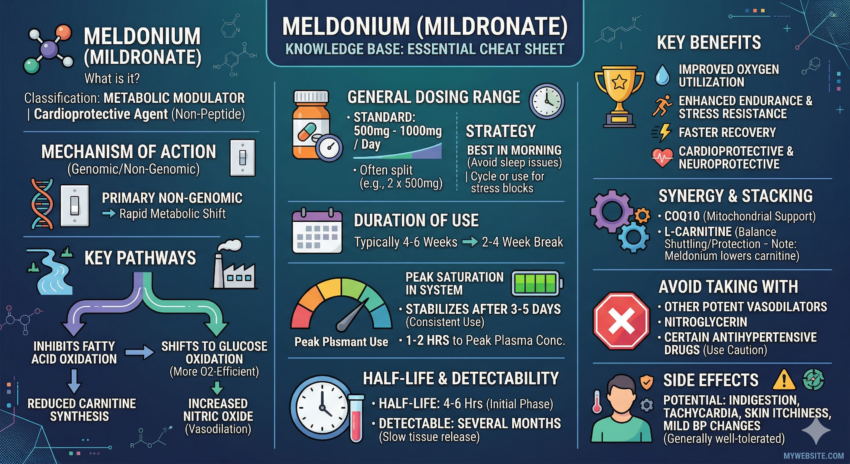
Meldonium is a unique metabolic modulator originally developed to support cardiovascular health and optimize energy metabolism under stress. It is widely used for enhancing physical work capacity and accelerating recovery.
Cheat Sheet Notes
- Classification: Metabolic Modulator / Cardioprotective Agent (Non-peptide). It is a structural analogue of gamma-butyrobetaine.
- Mechanism (Genomic/Non-Genomic): Primarily non-genomic. It acts as a competitive inhibitor of the enzyme BBOX, rapidly altering cellular metabolism without requiring gene expression changes.
- Key Pathways: * Inhibits fatty acid oxidation (by reducing carnitine synthesis).
- Shifts cellular energy production from fatty acids to glucose oxidation, which requires less oxygen per unit of ATP produced.
- Increases nitric oxide (NO) levels, leading to vasodilation.
- General Dosing Range: * Standard: 500 mg to 1,000 mg per day.
- Performance/Stress: Often split into two 500 mg doses (morning and mid-day).
- Dosing Strategy: Best taken in the morning to avoid potential sleep interference. Can be cycled or used acutely for high-stress training blocks.
- Duration of Use: Typically used in cycles of 4 to 6 weeks, followed by a 2 to 4-week break.
- Half-Life: Approximately 4 to 6 hours for the initial phase, though terminal elimination takes longer.
- Peak Saturation: Reaches peak plasma concentration in 1 to 2 hours; cellular “saturation” (metabolic shift) usually stabilizes after 3 to 5 days of consistent use.
- Detectability: Highly detectable in urine; remains in the system for several months due to slow terminal release from tissues.
- Key Benefits: * Improved oxygen utilization (anti-ischemic).
- Increased endurance and resistance to physical stress.
- Faster recovery between high-intensity sessions.
- Neuroprotective and cardioprotective properties.
- Synergy/Stacking: * L-Carnitine: Note that Meldonium lowers carnitine; some users stack them at different times of day to balance “shuttling” vs. “protection.”
- CoQ10: Supports mitochondrial health during the metabolic shift.
- Avoid Taking With: * Other potent vasodilators (may cause drops in blood pressure).
- Nitroglycerin or certain antihypertensive drugs (use caution).
- Side Effects: Generally well-tolerated. Potential issues include indigestion, tachycardia (fast heart rate), skin itchiness, or mild changes in blood pressure.
General Notes
Meldonium functions essentially as an “oxygen-sparing” agent. In environments where oxygen is limited—such as high-intensity training or hypoxic conditions—the body typically struggles to burn fat efficiently because fat oxidation requires a high volume of oxygen. By inhibiting the transport of long-chain fatty acids into the mitochondria, Meldonium forces the system to rely on glucose. This is a more efficient “fuel” under stress, allowing the heart and muscles to continue performing without accumulating toxic metabolic byproducts.
For athletes and fitness enthusiasts, the primary draw is the reduction in “oxygen debt.” This means you can maintain a higher pace for longer and recover your breath faster between sets or sprints. It doesn’t necessarily “stimulate” the central nervous system like caffeine; rather, it provides a smoother, more resilient metabolic foundation.
It is important to note that while Meldonium is legal for personal use in many regions, it has been on the WADA prohibited list since 2016. Because it binds so effectively to tissues, it can be detected in drug tests for many months after the final dose. From a health perspective, its ability to stimulate nitric oxide production also provides a nice “pump” and cardiovascular support, making it a versatile tool for both performance and longevity protocols.