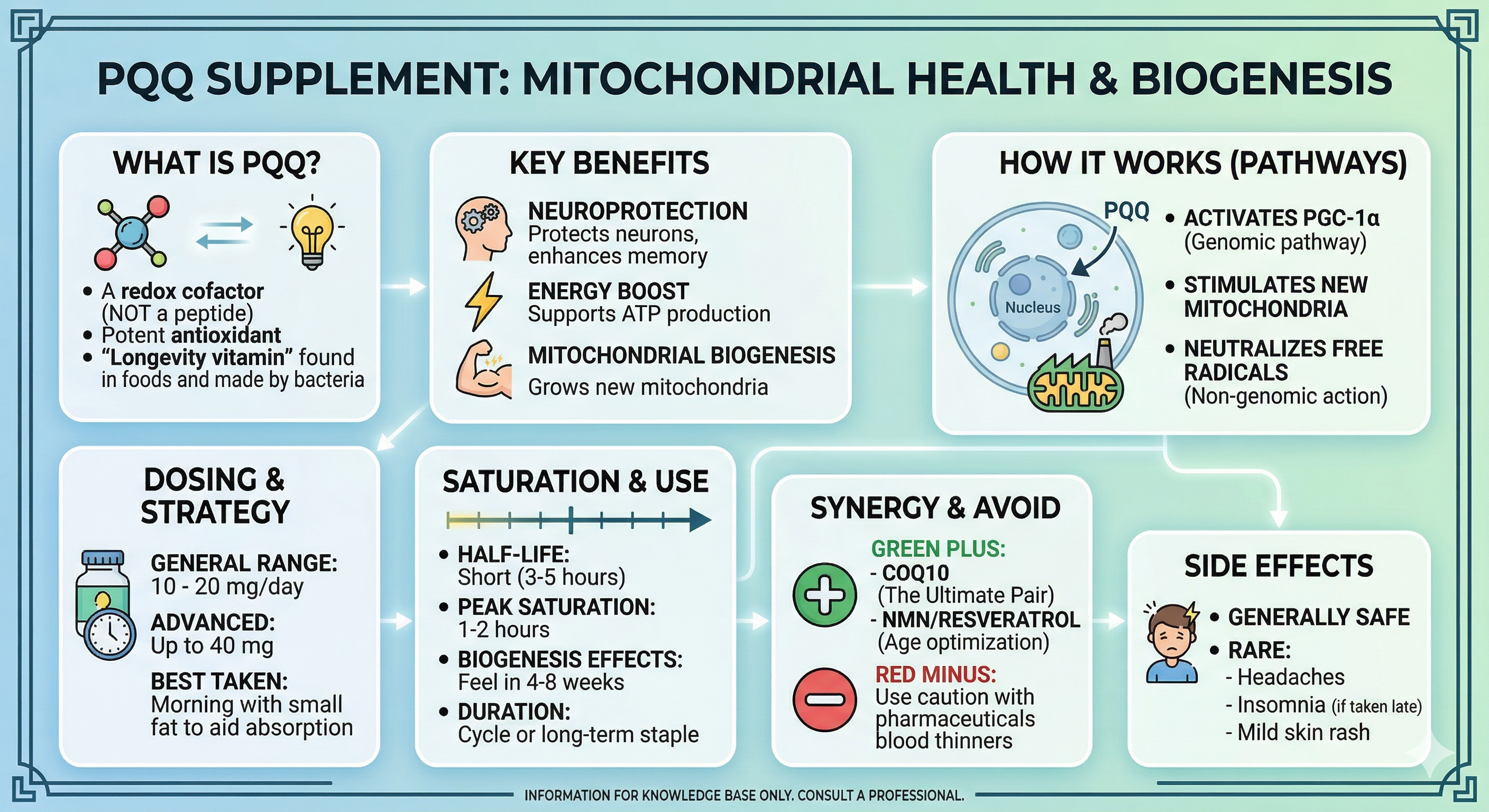
Classification
- Not a peptide.
- Classification: A redox cofactor and a “longevity vitamin.” It is a polyphenol-like compound found in certain foods and produced by some bacteria.
- Primary Role: Acts as an extremely potent antioxidant and a signaling molecule that promotes mitochondrial biogenesis.
Dosing & Strategy
- General Range: 10 mg to 20 mg per day.
- Advanced Range: Up to 40 mg (often used in clinical trials for cognitive recovery).
- Strategy: Best taken in the morning (due to potential energy boost) with a meal containing a small amount of fat to aid absorption.
Saturation & Half-Life
- Half-Life: Relatively short; roughly 3 to 5 hours in the blood.
- Peak Saturation: Reaches peak plasma concentration within 1–2 hours of ingestion.
- Systemic Saturation: While it works immediately as an antioxidant, the “biogenesis” effects (building new mitochondria) typically require 4 to 8 weeks of consistent use.
Mechanisms: Genomic vs. Non-Genomic
- Genomic: Primarily genomic. It triggers the PGC-1α pathway, which communicates with the cell’s nucleus to stimulate the production of new mitochondria.
- Non-Genomic: Acts directly as a redox agent, neutralizing superoxide and hydroxyl radicals through direct chemical interaction.
Key Benefits
- Mitochondrial Biogenesis: It doesn’t just fix old mitochondria; it helps grow new ones.
- Neuroprotection: Protects neurons from glutamate toxicity and oxidative stress.
- Cognitive Enhancement: Improves memory and attention span.
- Cardiovascular Health: Supports heart muscle energy requirements.
Pathways & Synergy
- Pathways: Activates AMPK, CREB, and PGC-1α.
- Synergy: * CoQ10: The gold standard pairing. While PQQ grows new mitochondria, CoQ10 helps them produce energy (ATP) more efficiently.
- Resveratrol/NMN: Works well with NAD+ precursors to optimize cellular aging pathways.
Side Effects & Safety
- Side Effects: Generally well-tolerated. Rare reports of headaches, insomnia (if taken too late), or mild skin rashes.
- Avoid: No major contraindications, but it is best to avoid taking it alongside high-dose pharmaceutical blood thinners without medical supervision, as its effect on platelet function is still being studied.
General Overview & Summary
PQQ is often called the “other CoQ10,” but that sells it short. While most antioxidants simply neutralize “rust” in the body, PQQ is one of the few substances capable of mitochondrial biogenesis. This means it encourages your cells to multiply their energy factories, effectively “turning back the clock” on cellular energy production. This makes it a staple in longevity protocols and “biohacking” stacks focused on brain fog and physical endurance.
In terms of duration, PQQ is not a “one-and-done” supplement. Because its primary value lies in remodeling your cellular infrastructure, it is best used in cycles of 12 weeks or as a long-term daily staple. Since it is water-soluble, it doesn’t build up to toxic levels easily, though following the standard 20 mg dose is usually sufficient for the vast majority of users.
It’s worth noting that PQQ is found naturally in human breast milk and foods like fermented soybeans (natto), green peppers, and kiwi—though you’d have to eat a mountain of them to reach the therapeutic levels found in a 20 mg capsule!