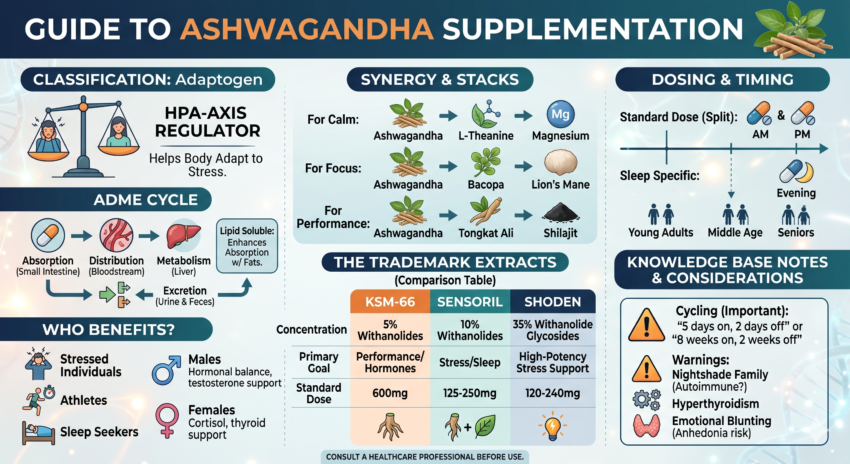
Ashwagandha (Withania somnifera), often referred to as “Indian Ginseng,” is the crown jewel of Ayurvedic medicine. It is a robust botanical that has transitioned from ancient tradition to a staple in modern performance and wellness protocols.
Classification
Ashwagandha is primarily classified as an Adaptogen.
- Mechanism: It works by modulating the HPA (Hypothalamic-Pituitary-Adrenal) axis, helping the body maintain homeostasis (balance) under physical, chemical, or emotional stress.
- Active Compounds: Its biological activity is largely attributed to a group of steroidal lactones known as withanolides.
ADME (Absorption, Distribution, Metabolism, Excretion)
- Absorption: Withanolides are lipid-soluble. When taken orally, they are absorbed in the small intestine. Bioavailability is significantly enhanced when consumed with a small amount of fat.
- Distribution: Once in the bloodstream, active compounds reach various tissues, notably the brain (crossing the blood-brain barrier) and endocrine glands.
- Metabolism: Primarily metabolized by the liver via various enzymatic pathways.
- Excretion: Eliminated through both urine and feces. Half-life varies based on the extract type but generally necessitates daily dosing to maintain steady-state levels.
Who Would Benefit?
- Stressed Individuals: Those with chronically elevated cortisol or “burnout” symptoms.
- Athletes: Individuals looking to improve recovery, VO2 max, and strength output.
- Those with Sleep Issues: It promotes “GABAergic” signaling, which helps quiet the nervous system for better sleep quality.
- Men Seeking Hormonal Support: It has a documented effect on improving sperm quality and modestly increasing testosterone in stressed or training populations.
Synergy with Other Supplements
- For Stress/Anxiety: Pairs well with L-Theanine or Magnesium Bisglycinate for a calming effect without sedation.
- For Cognitive Focus: Can be stacked with Bacopa Monnieri or Lion’s Mane.
- For Testosterone/Performance: Often used alongside Tongkat Ali or Shilajit for a multi-pathway approach to hormonal optimization.
- For Absorption: Best taken with a fat source (like Omega-3s or a meal).
Dosing & Timing
| Metric | Recommendation |
| Standard Dose | 300mg – 600mg of a high-potency extract (e.g., KSM-66 or Shoden). |
| Timing (General) | Split dose: morning and evening. |
| Timing (Sleep) | A single larger dose 60–90 minutes before bed. |
| Males | Higher end of the dose (600mg+) for strength and testosterone support. |
| Females | Standard dose (300–600mg) for cortisol management and thyroid support. |
Stages of Life
- Young Adults: Great for managing academic or entry-level career stress and athletic performance.
- Middle Age: Highly effective for balancing hormones during perimenopause or managing the “mid-career” cortisol spike.
- Seniors: May help with cognitive decline and maintaining muscle mass through cortisol suppression (preventing muscle breakdown).
Important Notes & Considerations
Nightshade Family: Ashwagandha belongs to the nightshade family. Those with extreme sensitivities or autoimmune conditions (like Crohn’s or Lupus) should monitor for inflammation.
Hyperthyroidism: Because it can stimulate thyroid hormone production (t4 to t3 conversion), those with hyperthyroidism should exercise caution.
Cycling: To prevent “anhedonia” (a rare side effect where users feel emotionally numb), some practitioners recommend cycling: 5 days on, 2 days off or 8 weeks on, 2 weeks off.
Not all Ashwagandha is created equal. It’s vital to distinguish between these trademarked extracts, as they serve different physiological goals based on their withanolide concentration and the parts of the plant used.
1. KSM-66: The “Full-Spectrum” Gold Standard
- Source: 100% Root extract.
- Potency: Standardized to 5% withanolides.
- Best For: Athletic performance, testosterone support, and recovery.
- Why it’s unique: It uses a “Green Chemistry” extraction process (traditionally involving milk) that maintains the natural ratios of the root. It is the most clinically studied extract for strength and hormonal health.
2. Sensoril: The Stress & Sleep Specialist
- Source: Blend of both Root and Leaves.
- Potency: Standardized to 10% (or higher) withanolides.
- Best For: Severe anxiety, chronic stress, and deep sleep.
- Why it’s unique: Because it uses the leaves, it contains higher levels of Withaferin A. It is significantly more “sedating” or calming than KSM-66. If a client has high evening cortisol, this is the go-to.
3. Shoden: The High-Potency Newcomer
- Source: Root and Leaves.
- Potency: Standardized to a massive 35% withanolide glycosides.
- Best For: Maximum cortisol suppression and cognitive “reset.”
- Why it’s unique: It has the highest bioavailability. You can achieve significant results with a much lower dose (e.g., 120mg–240mg) compared to the 600mg required for other extracts.
Comparison Table for the Knowledge Base
| Feature | KSM-66 | Sensoril | Shoden |
| Concentration | 5% Withanolides | 10% Withanolides | 35% Withanolides |
| Primary Goal | Performance/Hormones | Stress/Sleep | High-Potency Stress Support |
| Feel | Energizing/Balanced | Sedating/Calming | Very Potent/Anti-Inflammatory |
| Standard Dose | 600mg | 125mg – 250mg | 120mg – 240mg |
Integration Strategy
For the ultimate in ashwagandha protocols, you might consider using KSM-66 in the morning or pre-workout to leverage the performance benefits, while reserving Sensoril or Shoden for evening use to “turn off” the central nervous system.