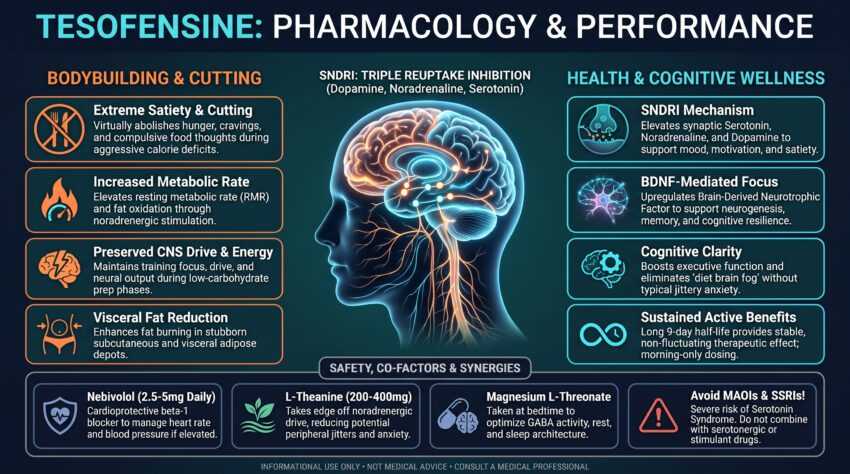
Classification: Triple Monoamine Reuptake Inhibitor (SNDRI) / Novel Anti-Obesity & Nootropic Agent (Non-Peptide Oral Compound)
Tesofensine Application Matrix
| Feature | Bodybuilding & Contest Cutting | General Weight Loss & Cognitive Wellness |
| Primary Goal | Sustained appetite elimination & anti-catabolic fat loss during steep deficits | Significant visceral & subcutaneous fat loss without severe calorie obsession |
| Secondary Goal | Preserving CNS drive, focus, and motivation during low-carb prep phases | Enhancing cognitive clarity, mood stabilization, and BDNF-mediated neuroprotection |
| Target Pathway | Central Inhibition of Serotonin, Noradrenaline, & Dopamine reuptake | Lateral hypothalamic satiety signaling & central dopaminergic motivation pathways |
| Dosing Range | 0.25 mg – 0.5 mg daily (taken in the morning) | 0.25 mg – 0.5 mg daily (titrated starting at 0.25 mg) |
| Key Synergies | GLP-1 Agonists (Semaglutide/Tirzepatide), L-Theanine, Nebivolol, Fasted Cardio | Magnesium L-Threonate, Alpha-GPC, L-Theanine, Collagen Peptides |
| Primary Constraint | Extremely long half-life (~9 days); steady state takes 3–4 weeks to accumulate | Mild heart rate elevation & insomnia if taken late in the day |
ADME Profile (Absorption, Distribution, Metabolism, Excretion)
- Absorption: Rapidly and near-completely absorbed following oral administration. High systemic bioavailability (~90%+). Peak plasma levels C_max occur within 7 to 12 hours post-ingestion.
- Distribution: Crosses the blood-brain barrier (BBB) efficiently, concentrating heavily in central brain structures including the hypothalamus, striatum, and prefrontal cortex. Exhibits high binding affinity for human monoamine transporters.
- Metabolism: Metabolized in the liver primarily via cytochrome P450 pathways (CYP3A4 and CYP2D6) into active and inactive cleavage metabolites.
- Excretion: Slow clearance, primarily via renal filtration and fecal elimination. Features a remarkably long terminal elimination half-life of approximately 220 hours (~9 days).
Quick Reference Guide
- Mechanism / Pathways:
- Triple Reuptake Inhibition (SNDRI): Potently inhibits the presynaptic reuptake of Noradrenaline
- Hypothalamic Satiety Regulation: Suppresses central appetite signaling in the lateral hypothalamic area while upregulating satiety responses in the arcuate nucleus.
- Thermic Energy Expenditure: Increases basal metabolic rate (BMR) and 24-hour fat oxidation through central noradrenergic activation of beta-adrenergic signaling.
- BDNF Upregulation: Increases Brain-Derived Neurotrophic Factor (BDNF) levels in the hippocampus, supporting synaptic plasticity and mood stability.
- Genomic vs. Non-Genomic: Primarily Non-Genomic.
- Non-Genomic: Direct, immediate blockade of monoamine transporter proteins, raising synaptic concentrations of neurotransmitters within hours.
- Genomic: Secondary downstream upregulation of BDNF gene expression and neuroplasticity factors following sustained monoaminergic stimulation.
- Key Benefits:
- Profound Satiety & Craving Control: Virtually abolishes hyperphagia, compulsive snacking, and sugar cravings by satisfying reward pathways.
- Accelerated Fat Oxidation: Increases resting metabolic rate (RMR) by ~6%–10% without voluntary exercise.
- Preserved Lean Tissue: Drives fat loss while sparing skeletal muscle tissue during aggressive caloric deficits.
- Nootropic & Executive Function Boost: Enhances mental sharpness, focus, drive, and cognitive endurance during prep deficits.
- Dosing Range:
- Starting Dose: 0.25 mg (250 mcg) once daily in the morning.
- Standard Effective Dose: 0.5 mg (500 mcg) once daily. Do not exceed 1.0 mg daily.
- Dosing Strategies:
- Morning Fasted Protocol: Take 0.25 mg – 0.5 mg immediately upon waking with a full glass of water. Because of its stimulating monoaminergic profile, taking it later in the day will disrupt sleep architecture.
- Steady-State Ramp Strategy: Start at 0.25 mg daily for weeks 1–3. Assess appetite control, resting heart rate, and sleep quality before determining if an increase to 0.5 mg is necessary, keeping in mind compound accumulation due to the 9-day half-life.
- Half-Life: Approximately 220 hours (~9 days). Steady-state plasma concentration is achieved after 3 to 4 weeks of consistent daily dosing.
- Peak Saturation: Reaches maximum serum concentrations within 7 to 12 hours post-ingestion.
- Duration of Use: Run in cycles of 12 to 24 weeks. Continuous long-term clinical trials demonstrate sustained efficacy without sudden desensitization.
- Detectability: Prohibited in competitive sports governed by WADA under Section S6 (Stimulants / Monoamine Reuptake Inhibitors). Detectable in blood and urine screens for 4 to 6 weeks post-discontinuation due to its long terminal half-life.
Technical Deep-Dive
1. Triple Monoamine Reuptake Inhibition & Central Satiety
Unlike traditional weight-loss drugs that focus strictly on one neurotransmitter (e.g., Sibutramine targeting Serotonin/Noradrenaline or phentermine targeting Noradrenaline), Tesofensine blocks the reuptake of all three major monoamines: Noradrenaline, Dopamine, and Serotonin. By maintaining elevated concentrations of these neurotransmitters in synaptic clefts across the hypothalamus, Tesofensine tricks the central nervous system into perceiving state of energy abundance. This shuts down hunger signals originating from NPY/AgRP neurons while activating satiety signaling via POMC/CART neurons.
2. Dopaminergic Drive & Thermic Energy Expenditure
Weight loss on traditional diets often stalls because the body lowers its basal metabolic rate (adaptive thermogenesis) and downregulates dopamine, leading to lethargy and food cravings. Tesofensine’s potent inhibition of the Dopamine Transporter DAT restores central reward pathway signaling, eliminating the compulsive urge to seek out hyper-palatable foods. Concurrently, its noradrenergic component stimulates peripheral $\beta_3$-adrenoceptors, increasing uncoupling protein-1 UCP-1 expression in adipose tissue and forcing the body to burn more calories as heat even at rest.
3. BDNF Elevation & Cognitive Protection
Originally developed as an investigational treatment for Alzheimer’s and Parkinson’s disease, Tesofensine exerts strong neuroprotective and neurotrophic effects. Sustained SNDRI activity increases hippocampal Brain-Derived Neurotrophic Factor (BDNF), a critical protein responsible for neurogenesis, memory consolidation, and synaptic plasticity. Athletes and clients report significant improvements in executive functioning, mood stabilization, and mental stamina, avoiding the typical “diet brain” fog associated with deep fat-loss phases.
Safety, Side Effects & Contraindications
Common & Dose-Dependent Side Effects
- Dry Mouth (Xerostomia): The most frequently reported clinical side effect due to central noradrenergic stimulation.
- Elevated Resting Heart Rate: Mild to moderate increase in baseline HR (typically 3–8 BPM increase) and slight elevation in blood pressure.
- Insomnia / Altered Sleep Architecture: Difficulty falling asleep if taken late in the day or if steady-state levels trigger excessive central activation.
- Gastrointestinal Effects: Mild constipation, nausea, or transient abdominal discomfort during initial titration.
- Mild Agitation or Jitteriness: Occurs primarily if combined with heavy central nervous system stimulants like caffeine.
Absolute Contraindications
- Concomitant Use of SSRIs, SNRIs, or MAOIs: Combining Tesofensine with serotonergic medications carries a severe risk of Serotonin Syndrome (a potentially life-threatening hyper-serotonergic state). Allow a 14-day wash-out period.
- Uncontrolled Hypertension or Severe Cardiovascular Disease.
- History of Bipolar Disorder, Psychosis, or Severe Anxiety Disorders.
- Active Pregnancy or Lactation.
Synergistic Supplements & Countermeasures
To control heart rate elevation, optimize sleep architecture, and amplify fat-loss mechanics, the following co-factor stack should accompany Tesofensine administration:
- L-Theanine (200 mg – 400 mg daily): Essential Calming Co-Factor. Takes the sharp edge off noradrenergic stimulation, reducing peripheral jitters and anxiety while enhancing focus.
- Magnesium L-Threonate / Glycinate (300 mg – 400 mg at bedtime): Supports central GABA activity, counteracts daytime monoaminergic stimulation, and protects sleep architecture.
- Nebivolol (2.5 mg – 5 mg daily): A highly selective beta_1-adrenergic blocker. Protects against Tesofensine-induced increases in resting heart rate and blood pressure without interfering with fat loss.
- GLP-1 Agonists (Semaglutide / Tirzepatide): The ultimate fat loss combination. Pairing a central SNDRI (Tesofensine) with a peripheral gut-brain hormone mimetic (GLP-1) attacks appetite through two completely independent pathways, allowing lower doses of both compounds while maximizing total fat loss.
What to Avoid
- SSRIs, SNRIs, & Serotonergic Peptides: Dangerous Combination. Never mix Tesofensine with Fluoxetine, Sertraline, Venlafaxine, or 5-HTP due to Serotonin Syndrome risks.
- High-Dose Central Stimulants: Avoid combining with high doses of Caffeine, Ephedrine, or Amphetamines, which cause compounding cardiovascular strain and severe sleep disruption.
- Late-Day Dosing: Taking Tesofensine after 10:00 AM will severely impair slow-wave and REM sleep due to its active half-life and central mechanism.
General Coaching Notes
Tesofensine represents a massive evolution in non-peptide, oral weight loss pharmacology. Unlike traditional stimulants that force fat loss by over-taxing the sympathetic nervous system, Tesofensine works centrally by modulating the brain’s fundamental reward and satiety centers.
The critical factor to manage when coaching clients on Tesofensine is its 9-day half-life. Because the compound takes 3 to 4 weeks to reach true steady-state concentrations in blood plasma, the full therapeutic effect of a 0.25 mg dose will not be fully apparent on Day 3. Impatient clients often make the mistake of doubling their dose during Week 1, only to experience severe insomnia, elevated heart rate, and anxiety by Week 3 as the drug accumulates in their system. Patience and conservative titration are mandatory.
For athletes in deep contest prep, Tesofensine is a game-changer. It eliminates the grueling mental fog and obsessive food cravings that typically derail low-calorie phases, allowing clients to maintain high cognitive output and training motivation while shedding stubborn fat. When paired with L-Theanine for neuro-smoothness and Nebivolol for cardiovascular protection, Tesofensine is one of the most effective tools available for modern body recomposition.