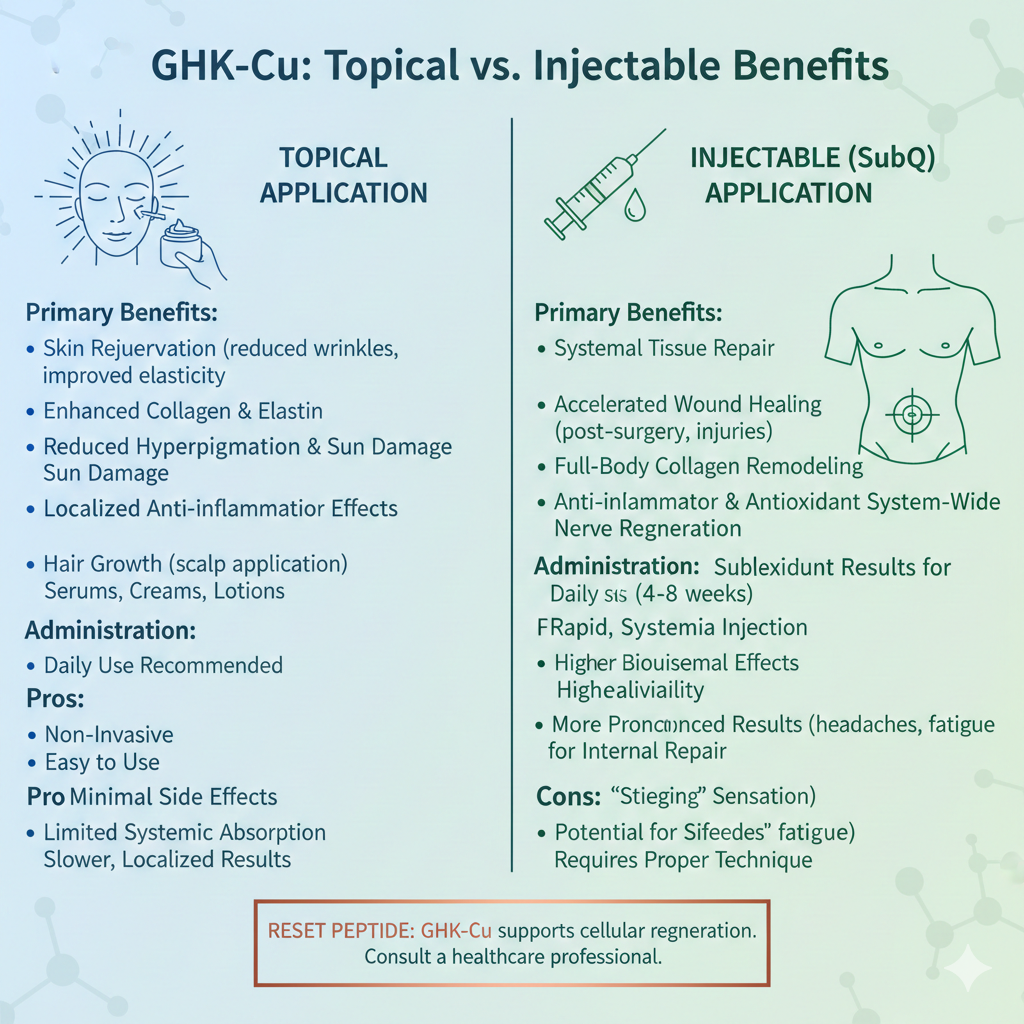
This cheat sheet provides a streamlined overview of GHK-Cu, a naturally occurring copper complex that has gained significant traction in regenerative medicine and skincare.
Core Profile
- Classification: It is a peptide (specifically a tripeptide) naturally found in human plasma that complexes with copper (II).
- Genomic vs. Non-Genomic: It acts on both levels. It influences genomic expression (remodeling over 4,000 human genes) and non-genomic pathways (direct antioxidant activity and mineral transport).
- Half-Life: Very short, approximately 0.5 to 1 hour.
- Time to Peak Saturation: Reaches peak plasma concentration rapidly (within minutes of injection), but “steady-state” biological effects on tissue remodeling take 2–4 weeks of consistent use.
- Detectability: Not currently on standard WADA/anti-doping banned lists, but always check specific organizational guidelines.
Dosing & Administration
- General Dosing Range: * Subcutaneous: 1mg to 2mg per day.
- Topical: 1% to 3% concentration in serums or creams.
- Strategies: * Cycle Length: 4 to 8 weeks, followed by a 4-week break to prevent copper toxicity or zinc imbalance.
- Injection Site: Usually subcutaneous in the abdomen or localized near an injury.
Key Benefits & Pathways
- Key Benefits: * Accelerated wound healing and skin remodeling.
- Increased synthesis of collagen, elastin, and glycosaminoglycans.
- Anti-inflammatory and antioxidant effects.
- Improved hair growth and follicle size.
- Nerve regeneration and cognitive support.
- Pathways: Primarily works through the ubiquitin-proteasome system, activation of antioxidant enzymes (SOD), and modulation of metalloproteinases (MMPs).
Side Effects & Interactions
- Side Effects: Injection site soreness (it is known to “sting”), localized redness, mild headaches, or fatigue if the dose is too high.
- Synergy (What to add): * Zinc Supplementation: Essential to maintain the zinc-copper ratio.
- BPC-157: Often stacked for superior connective tissue repair.
- Vitamin C: Aids in collagen synthesis.
- Avoid Taking With: * High-dose Vitamin C (at the same time): Can potentially destabilize the copper bond if mixed in the same syringe or applied topically at the exact same moment.
- Chelating agents: Substances that strip minerals from the body.
Summary & General Notes
GHK-Cu is often referred to as the “Reset Peptide” because of its unique ability to revert aged or damaged cells to a more youthful, healthy state. Unlike many synthetic compounds, GHK-Cu is endogenous to the human body, though levels decline significantly as we age (dropping by roughly 60% by age 60). Its primary power lies in collagen modulation; it doesn’t just produce more collagen, it helps the body break down “bad” or scarred collagen and replace it with healthy tissue.
When using GHK-Cu, the “sting” factor is a common complaint. Many researchers dilute the peptide with more bacteriostatic water than usual to minimize discomfort during subcutaneous administration. It is also worth noting that because GHK-Cu is a potent copper carrier, long-term use without monitoring mineral levels can lead to a zinc deficiency, which may manifest as a weakened immune system or lethargy.
In a clinical or research setting, GHK-Cu is prized for its versatility. Whether used topically for aesthetics or systemically for systemic inflammation and tissue repair, it remains one of the most well-studied and safety-profiled peptides on the market.