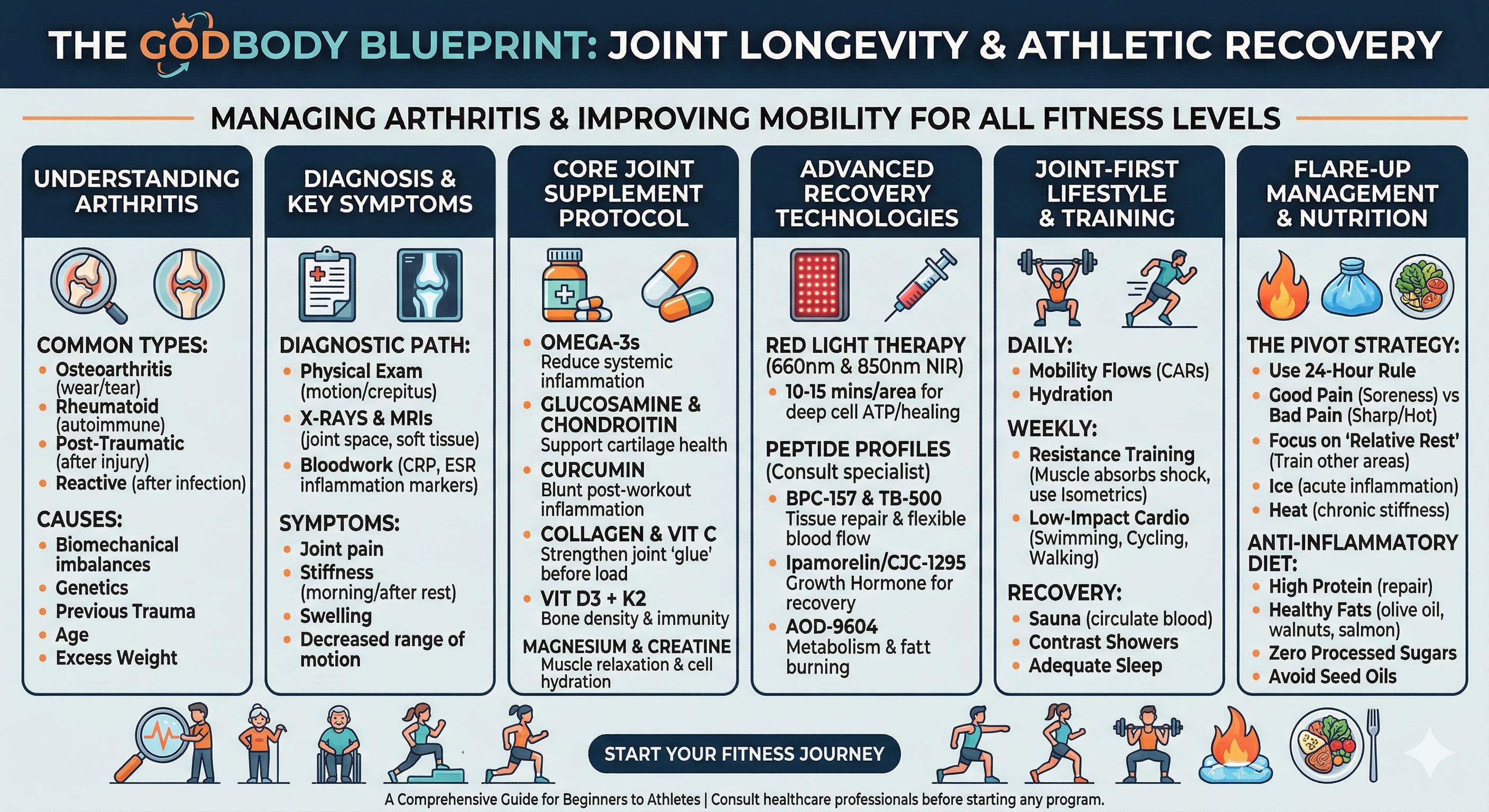
This comprehensive guide bridges the gap between the casual beginner and the high-level athlete. Whether you are managing chronic joint issues or bulletproofing your body for a new fitness journey, the goal remains the same: maximizing performance while minimizing systemic inflammation.
1. Understanding Arthritis: The Foundation
Arthritis is not a single disease; it is an umbrella term for over 100 conditions characterized by joint inflammation, pain, and structural damage. For athletes and beginners alike, understanding the “why” behind the pain is the first step toward a solution.
Common Types
- Osteoarthritis (OA): The most common “wear and tear” variety. The protective cartilage at the ends of bones wears down over time. In athletes, this is often driven by repetitive high-impact loading; in beginners, it may stem from inactivity or carrying excess weight.
- Post-Traumatic Arthritis: Specifically follows a joint injury (e.g., meniscus tear, ACL rupture). Even after “healing,” the joint mechanics are permanently altered, accelerating cartilage decay.
- Inflammatory/Autoimmune (e.g., Rheumatoid): The immune system mistakenly attacks the joint lining (synovium). This is systemic, meaning it can affect multiple joints regardless of how much you use them.
- Reactive Arthritis: Often follows an infection elsewhere in the body; it can cause sudden, debilitating swelling that can derail a new fitness routine.
Causes & Diagnosis
- Causes: Genetics, age, previous trauma, and biomechanical imbalances. If one muscle group is weak, another must overwork, leading to joint shearing.
- The Diagnostic Path:
- Physical Exam: Checking for “crepitus” (grinding), range of motion, and joint effusion (fluid).
- Imaging: X-rays show “bone-on-bone” narrowing; MRIs reveal soft tissue damage and early cartilage thinning.
- Bloodwork: Testing for C-Reactive Protein (CRP) or Erythrocyte Sedimentation Rate (ESR) to measure systemic inflammation levels.
2. The Comprehensive Supplement Protocol
Timing is critical. Supplements for joints work best when paired with blood flow (movement).
| Supplement | Recommended Dose | Timing | Focus |
| Omega-3 (EPA/DHA) | 2,000–3,000mg | With a fatty meal | Systemic anti-inflammatory “oil” for the joints. |
| Collagen Peptides | 10–15g | 45–60 min before training | Best absorbed when the joint is under mechanical load. |
| Curcumin (Turmeric) | 500–1,000mg | Post-workout | Targets the NF-kB pathway to blunt “bad” inflammation. |
| Glucosamine Sulfate | 1,500mg | Morning | Provides the building blocks for cartilage repair. |
| Magnesium Glycinate | 300–400mg | Before bed | Relaxes muscles and prevents night-time joint cramping. |
| Creatine Mono | 5g | Daily | Aids cellular hydration; keeps the “cushion” in the joint. |
| Vitamin D3 + K2 | 2,000–5,000 IU | With breakfast | Essential for bone density and immune regulation. |
3. Advanced Recovery: Peptides & Light Therapy
For those looking to push beyond basic nutrition, these tools offer targeted cellular signaling for repair.
The Peptide Profile
- BPC-157 (Body Protection Compound): Highly regarded in the fitness community for its potential to accelerate the healing of tendons, ligaments, and even gastric tissue. It is often used to “spot treat” localized injuries.
- TB-500 (Thymosin Beta-4): Works systemically to promote angiogenesis (new blood vessel growth) and tissue flexibility. Often paired with BPC-157 for a synergistic effect.
- Ipamorelin / CJC-1295: These “secretagogues” encourage your body to pulse its own growth hormone, which significantly improves deep sleep and systemic recovery.
Red Light & Near-Infrared (RLT/NIR)
- Red Light (630–660nm): Focuses on surface inflammation and skin health.
- Near-Infrared (800–850nm): The “Gold Standard” for arthritis. It penetrates deep into the joint capsule to stimulate mitochondrial ATP production.
- The Protocol: 10–15 minutes per area, 5–7 days a week. Use it pre-workout to “prime” the tissue or post-workout to speed up cellular cleanup.
4. The “Joint-First” Lifestyle Integration
Success is found in the weekly rhythm. High-intensity training must be balanced with low-intensity “flushing.”
Sample Weekly Schedule
- Mon/Wed/Fri (Strength): Resistance training is mandatory. Muscle acts as a shock absorber for your joints. Focus on “Isometrics” (holds) if a joint is feeling spicy.
- Tue/Thu (Mobility & Flow): 20 minutes of CARs (Controlled Articular Rotations) and light walking or swimming. This “moves the grease” (synovial fluid) through the joint.
- Daily: 10 mins of RLT; hydration (aim for 3–4 liters of water to keep joints lubricated).
- Weekends: Recovery focus. Sauna (heat for stiffness) or Contrast Showers (30s cold/30s hot) to move lymph fluid and reduce swelling.
5. Flare-Up Management: The “Pivot” Strategy
When pain increases, do not stop moving. Total inactivity causes joints to “rust” shut.
- The 24-Hour Rule: If pain is worse the day after a session, you exceeded your “Maximum Recoverable Volume.” Reduce the next session’s load by 20%.
- The “Good vs. Bad” Pain Check:
- Good: Aching, burning, diffuse muscle soreness. Keep going.
- Bad: Sharp, localized, stabbing, or “hot” joints. Stop and pivot.
- Relative Rest: If your knees flare, do not skip the gym. Train upper body or core. Keeping the systemic “engine” running promotes overall healing.
- Ice vs. Heat: Use Ice for 10–15 mins for acute, “hot” swelling. Use Heat for morning stiffness or to prep a joint for movement.
6. The Anti-Inflammatory Nutrition Philosophy
Diet is the “gasoline” you put in the tank. If you eat inflammatory foods, your joints will feel it.
- The Foundation: High-quality protein (grass-fed beef, wild-caught fish, eggs) to provide the amino acids for tissue repair.
- The “Joint” Fats: Extra virgin olive oil, avocado, and walnuts.
- The “Avoid” List: Refined sugars, seed oils (canola/soybean), and excessive alcohol. These are “pro-inflammatory” signals that can trigger a flare-up overnight.
Nutrition: AIP vs. Mediterranean: Which is for you?
The AIP Diet (Best for Rheumatoid/Autoimmune Arthritis)
AIP is designed specifically for autoimmune conditions (Rheumatoid, Psoriatic, Lupus). It works on the “Leaky Gut” theory, removing every potential trigger that could cause your immune system to misfire.
- The Pro: It is the “nuclear option” for identifying hidden food sensitivities (like nightshades, eggs, or nuts) that might be causing your specific flare-ups.
- The Con: It is extremely restrictive. It eliminates grains, legumes, dairy, eggs, nuts, seeds, and nightshades (potatoes, tomatoes, peppers).
The Mediterranean Diet (Best for Osteoarthritis & Beginners)
If your arthritis is primarily “wear and tear” (Osteoarthritis), the Mediterranean diet is the gold standard.
- The Pro: It is much easier to follow and is backed by decades of research for reducing joint pain and protecting the heart.
- The Con: It allows nightshades and grains, which a small percentage of people find inflammatory.
2. Is AIP Sustainable for an Athlete?
This is the biggest hurdle. For someone with high activity levels, AIP presents two major challenges:
- Fueling: Most “quick” athlete carbs (oats, rice, pasta) are banned. You have to rely heavily on sweet potatoes, plantains, and fruit for energy.
- Convenience: Finding “on-the-go” AIP-compliant protein is hard because most powders (whey, soy, pea) and bars (nuts/seeds) are off-limits. You’ll need to rely on beef isolate or collagen-based proteins.
3. The Hybrid Approach
Instead of jumping straight into full AIP—which often leads to burnout and quitting— we recommend a phased approach:
Phase 1: The “Clean Slate” (4 Weeks)
Start with a Mediterranean-style diet but remove the “Big Three” common triggers:
- Refined Sugar
- Seed Oils (Canola, Vegetable, Soybean)
- Gluten
Phase 2: The AIP “Deep Dive” (Only if needed)
If you still have significant joint pain after Phase 1, move into a 2-week AIP elimination.
- Cut out nightshades (potatoes/tomatoes), eggs, and nuts.
- If your pain vanishes, you’ve found your triggers. If it doesn’t change, these foods aren’t your problem, and you can bring them back.
4. Summary Table: AIP vs. Standard Anti-Inflammatory
| Feature | AIP Diet | Standard Anti-Inflammatory |
| Primary Goal | Identify autoimmune triggers | Lower systemic inflammation |
| Grains/Legumes | Strictly Forbidden | Whole grains/beans encouraged |
| Eggs/Nuts/Seeds | Forbidden (in elimination phase) | Encouraged (healthy fats/protein) |
| Nightshades | Forbidden (Potatoes, Tomatoes) | Allowed |
| Difficulty | High (Requires 100% home cooking) | Moderate (Sustainable eating out) |