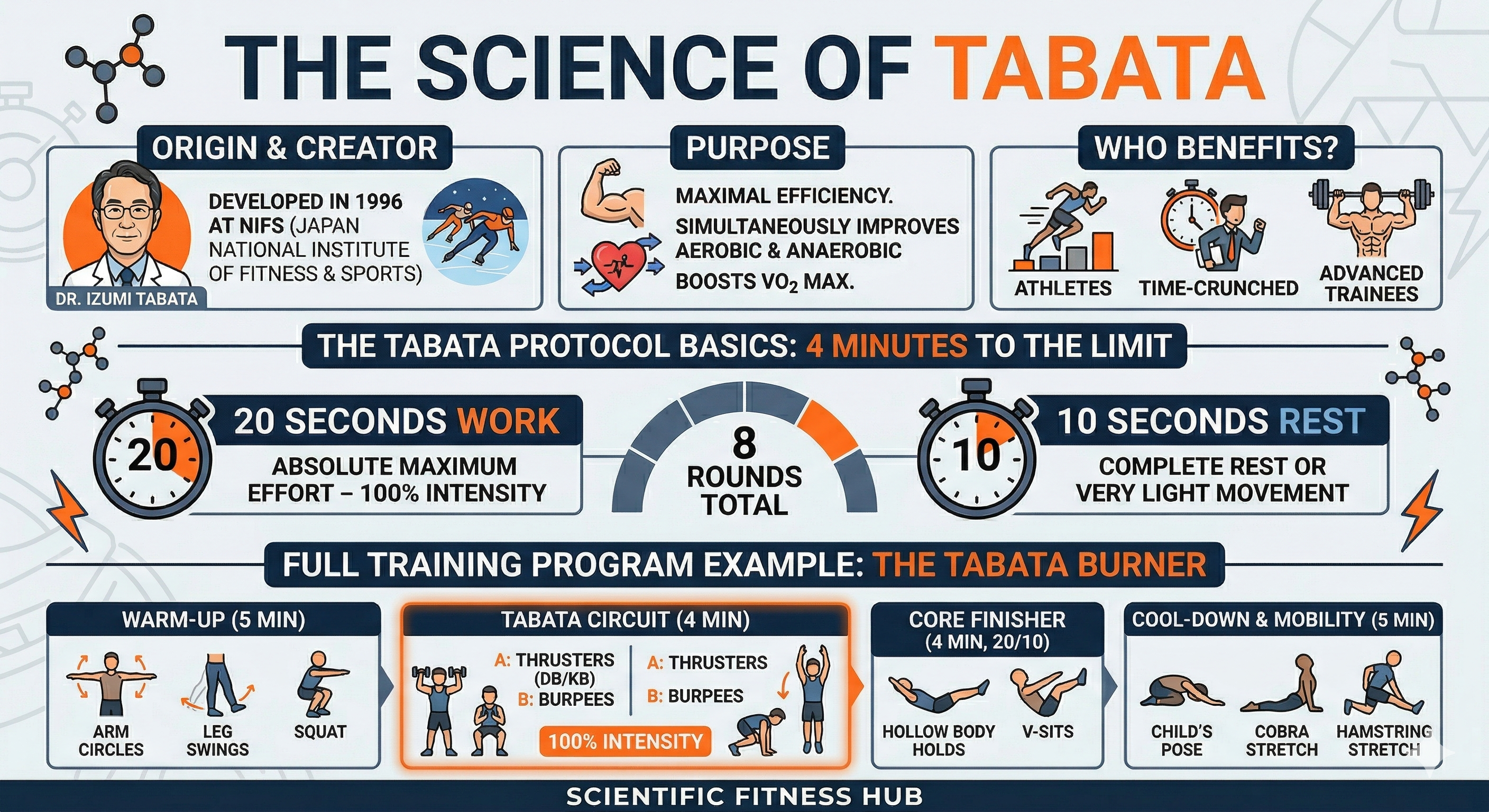
Tabata has become a buzzword in the fitness industry, often used interchangeably with generic “HIIT.” However, true Tabata is a specific, high-intensity protocol backed by rigorous sports science. Whether you are looking to shatter a performance plateau or maximize fat loss in minimal time, understanding this method is key.
The Origins: From Speed Skating to Science
Tabata wasn’t born in a trendy commercial gym; it was developed in a lab.
- The Creator: Dr. Izumi Tabata, a Japanese researcher.
- The Origin: In 1996, Dr. Tabata conducted a study at the National Institute of Fitness and Sports in Tokyo.
- The Inspiration: He analyzed the training of the Japanese national speed skating team, looking for the most efficient way to improve both aerobic and anaerobic pathways simultaneously.
The Purpose: Maximal Efficiency
The primary goal of the Tabata protocol is to push the body to its absolute limit ($VO_2$ max) in a very short duration. Unlike steady-state cardio, which primarily targets aerobic capacity, Tabata forces the body to adapt to extreme oxygen debt, drastically improving metabolic rate and cardiovascular endurance.
Who Benefits?
- Athletes: Those looking to increase explosive power and anaerobic threshold.
- The Time-Crunched: Individuals who need an effective workout but have less than 20 minutes to spare.
- Bodybuilders/Fitness Enthusiasts: Ideal for maintaining muscle mass while shedding body fat due to the high metabolic demand.
- Advanced Trainees: Because of the intensity required, this is best suited for those with a solid fitness foundation.
The Protocol Basics
A true Tabata session consists of eight rounds of high-intensity intervals. The math is simple but brutal:
- 20 Seconds Work: Absolute maximum effort (100% intensity).
- 10 Seconds Rest: Complete standstill or very light movement.
- Repeat: 8 times total.
- Total Time: 4 minutes.
The God Body Tabata Burner (Full Program)
To get the most out of this, you must choose compound movements that recruit the most muscle fibers. Below is a structured 20-minute session including a proper warm-up and cool-down.
1. Warm-Up (5 Minutes)
- Arm Circles: 30 seconds
- Leg Swings: 30 seconds per side
- Bodyweight Squats: 1 minute (controlled)
- Mountain Climbers: 1 minute (moderate pace)
- Jump Rope or Shadow Boxing: 1 minute
2. The Tabata Circuit (4 Minutes)
Perform 20s ON / 10s OFF for 8 rounds. Alternate between Exercise A and Exercise B.
| Round | Exercise | Intensity |
| 1 | A: Thrusters (Dumbbell or Kettlebell) | 100% |
| 2 | B: Burpees (Chest to floor) | 100% |
| 3 | A: Thrusters | 100% |
| 4 | B: Burpees | 100% |
| 5 | A: Thrusters | 100% |
| 6 | B: Burpees | 100% |
| 7 | A: Thrusters | 100% |
| 8 | B: Burpees | 100% |
3. Core Finisher (Optional – 4 Minutes)
Standard 20/10 protocol using core-focused movements.
- Hollow Body Holds (Rounds 1, 3, 5, 7)
- V-Sits (Rounds 2, 4, 6, 8)
4. Cool-Down & Mobility (5 Minutes)
- Child’s Pose: 1 minute
- Cobra Stretch: 1 minute
- Hamstring Stretch: 1 minute per side
Note: True Tabata is taxing on the central nervous system. It is recommended to perform this protocol no more than 2–3 times per week to allow for proper recovery.