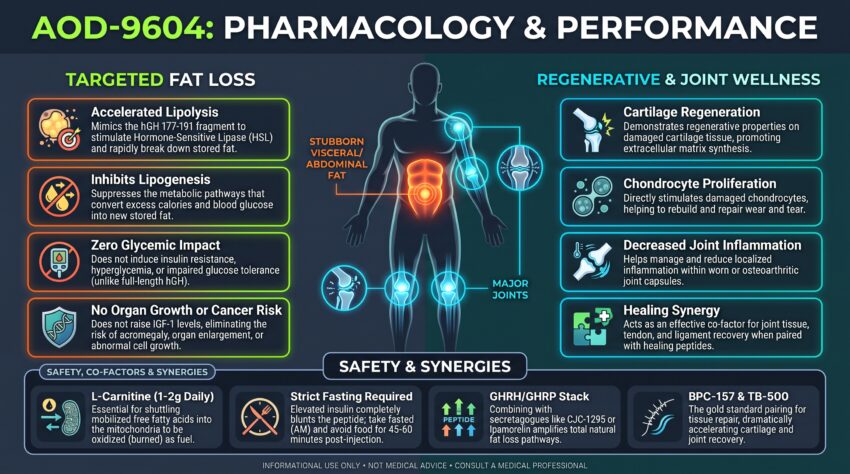
Classification: C-terminal Fragment of Human Growth Hormone (Tyr-hGH 177–191 Derivative) / Lipolytic Peptide (Injectable Peptide Compound)
AOD-9604 Application Matrix
| Feature | Targeted Fat Loss & Body Composition | Cartilage Repair & Regenerative Wellness |
| Primary Goal | Selective subcutaneous & visceral adipose reduction without glycemic disruption | Intra-articular / systemic cartilage regeneration & joint repair support |
| Secondary Goal | Inhibition of lipogenesis (preventing conversion of non-fatty foods into fat) | Synergistic tissue healing when paired with regenerative peptides (BPC-157/TB-500) |
| Target Pathway | beta_3-adrenergic receptor activation on adipocytes & HSL up-regulation | Extracellular matrix synthesis & chondrocyte proliferation cascades |
| Dosing Range | 250 mcg – 500 mcg SubQ daily (dosed fasted) | 300 mcg – 500 mcg SubQ or intra-articular daily |
| Key Synergies | L-Carnitine, CJC-1295 / Ipamorelin, Tesamorelin, Cardarine, Fasted Cardio | BPC-157, TB-500, GHK-Cu, Collagen Peptides |
| Primary Constraint | Blunted completely by elevated insulin levels (requires strict fasted administration) | Short active plasma half-life requires precise daily compliance |
ADME Profile (Absorption, Distribution, Metabolism, Excretion)
- Absorption: Highly bioavailable when administered via subcutaneous (SubQ) injection. Systemic uptake is rapid, with peak plasma concentrations C_max reached within 15 to 30 minutes post-injection.
- Distribution: Distributes quickly through peripheral circulation, displaying high tissue affinity for adipose cell membrane receptors beta_3adrenoceptors) and vascularized subcutaneous fat stores. Does not cross the blood-brain barrier in significant quantities.
- Metabolism: Rapidly cleaved by endogenous blood plasma proteases and peptidases into smaller, inactive peptide amino acid chains. Because it lacks the full 191-amino acid tertiary structure of intact hGH, it does not bind to hepatic hGH receptors or stimulate IGF-1 production.
- Excretion: Hydrolyzed down into constituent amino acids, which are recycled into the systemic protein pool or cleared via renal filtration in urine.
Quick Reference Guide
- Mechanism / Pathways:
- Selective Lipolysis Stimulation: Mimics the isolated lipolytic region of human growth hormone (hGH 177–191 with an added tyrosine terminal residue), stimulating Hormone-Sensitive Lipase (HSL) in fat cells.
- Lipogenesis Inhibition: Suppresses the enzymatic pathways responsible for converting circulating blood glucose and fatty acids into stored triglycerides within adipocytes.
- Non-Diabetogenic / Non-Mitogenic: Operates completely independent of the insulin receptor and Growth Hormone Receptor GHR pathways, causing zero suppression of glucose clearance and zero elevation of Insulin-like Growth Factor 1 IGF-1.
- Genomic vs. Non-Genomic: Primarily Non-Genomic.
- Non-Genomic: Direct activation of secondary messenger cascades (cAMP) and phosphorylation of lipolytic enzymes within minutes of binding to adipocyte membrane receptors.
- Genomic: Secondary down-regulation of lipid-storage transcriptional factors following prolonged reduction of intracellular lipid droplet volume.
- Key Benefits:
- Targeted Adipose Reduction: Accelerates fat burning in stubborn subcutaneous and visceral adipose depots.
- Zero Glycemic Impact: Does not induce insulin resistance, hyperglycemia, or impaired glucose tolerance (unlike full-length hGH).
- No Organ Growth or Cancer Risk: Does not stimulate $\text{IGF-1}$ levels, eliminating risks of acromegaly, organomegaly, or unwanted tissue proliferation.
- Joint & Cartilage Support: Demonstrates regenerative properties on damaged cartilage tissue and chondrocytes, especially when combined with hyaluronic acid or healing peptides.
- Dosing Range:
- Standard Fat Loss Dose: 250 mcg – 500 mcg once daily (SubQ).
- Advanced / Split Protocol: 250 mcg in the morning (fasted) + 250 mcg mid-afternoon (fasted/pre-cardio).
- Dosing Strategies:
- Fasted Morning Protocol (Gold Standard): Administer 250 mcg – 300 mcg SubQ immediately upon waking. Maintain a strict fast (no calories, carbohydrates, or fats—only water/black coffee) for at least 45 to 60 minutes post-injection to allow lipolysis to peak unhindered by insulin.
- Pre-Cardio Acceleration: Administer 250 mcg SubQ 30 minutes prior to steady-state fasted cardio to maximize free fatty acid oxidation.
- Half-Life: Approximately 30 minutes in plasma; however, its metabolic signaling cascade and lipolytic enzymatic activation persist for several hours post-injection.
- Peak Saturation: Reaches Cmax within 15 to 30 minutes post-injection.
- Duration of Use: Run in cycles of 8 to 12 weeks continuous use for maximum fat remodeling and body re-composition.
- Detectability: Prohibited by WADA under Section S2 (Peptide Hormones, Growth Factors, Related Substances, and Mimetics). Detectable via liquid chromatography-mass spectrometry (LC-MS) urine/blood screening for 7 to 14 days post-administration.
Technical Deep-Dive
1. Targeted Lipolysis Without Glycemic or IGF-1 Disruption
Full-length human Growth Hormone (hGH) is a double-edged sword: while it is an effective lipolytic agent, its N-terminal region induces peripheral insulin resistance, impairs glucose uptake, and stimulates hepatic IGF-1 production. AOD-9604 isolates amino acids 177–191 at the C-terminus (modified with a tyrosine residue for stability). This exact fragment retains 100% of hGH’s fat-burning capability by binding beta_3-adrenoceptors and elevating cAMP inside fat cells, while completely discarding the diabetogenic and growth-stimulating regions.
2. Dual Action: Lipolysis Activation + Lipogenesis Inhibition
Most fat loss compounds (such as caffeine or clenbuterol) only increase the rate at which stored fat is broken down (lipolysis). AOD-9604 operates via a dual-action mechanism: it simultaneously accelerates lipolysis (breakdown of existing fat) and inhibits lipogenesis (the metabolic pathway that converts excess calories and circulating fatty acids into new triglycerides). This dual mechanism prevents rebound fat accumulation, making it particularly effective for locking in physique changes during maintenance or caloric deficits.
3. Chondrogenic & Cartilage Regenerative Potential
Beyond adipose tissue, research highlights AOD-9604’s affinity for cartilage repair. The peptide stimulates proteoglycan and collagen synthesis in damaged chondrocytes. In osteoarthritic and joint injury models, AOD-9604 acts synergistically with extracellular matrix components to promote cartilage repair, reduce joint inflammation, and improve joint mobility without stimulating unwanted systemic tissue growth.
Safety, Side Effects & Contraindications
Common & Dose-Dependent Side Effects
- Mild Injection Site Reaction: Transient redness, slight swelling, or localized itching at the SubQ injection site.
- Mild Headaches / Flushing: Rare, temporary lightheadedness or facial flushing immediately following injection due to minor microvascular shifts.
- Mild GI Discomfort: Occasional mild nausea if injected too close to a heavy meal.
Absolute Contraindications
- Known hypersensitivity or allergy to synthetic hGH fragments or peptide preservatives (e.g., benzyl alcohol / bacteriostatic water).
- Active pregnancy or lactation (insufficient clinical safety data in human gestation).
- Severe acute gastrointestinal impairment or malabsorption disorders.
Synergistic Supplements & Countermeasures
To maximize fat oxidation, protect joint tissues, and maintain optimal physiological conditions, the following stack should accompany AOD-9604 administration:
- Injectable L-Carnitine (1,000 mg – 2,000 mg daily): Essential Synergist. AOD-9604 mobilizes free fatty acids (FFAs) into the bloodstream; L-Carnitine acts as the shuttling enzyme that transports those FFAs across the mitochondrial membrane to be oxidized (“burned”) as fuel.
- CJC-1295 / Ipamorelin or Tesamorelin: Combining AOD-9604 with a GHRH/GHRP peptide blend creates a powerful synergistic environment. The secretagogues stimulate endogenous GH pulses, while AOD-9604 provides targeted C-terminal lipolytic action.
- Cardarine (GW501516): Upregulates PPAR delta activation, dramatically increasing lipid oxidation capacity during steady-state aerobic exercise.
- BPC-157 (250 mcg – 500 mcg daily): When using AOD-9604 for joint, tendon, or cartilage rehabilitation, pairing it with BPC-157 accelerates tissue remodeling and collagen synthesis.
What to Avoid
- Injecting Near Meals (Insulin Elevation): The #1 Mistake. Insulin is a potent inhibitor of lipolysis. Administering AOD-9604 within 2 hours of consuming carbohydrates or fat nullifies the lipolytic efficacy of the peptide.
- Expecting CNS Stimulant-Style “Jitters”: AOD-9604 works on metabolic enzymatic pathways, not the central nervous system. Do not increase dosage expecting a caffeine-like boost.
- Reconstituted Room-Temperature Storage: Once reconstituted with bacteriostatic water, AOD-9604 must remain refrigerated and protected from direct sunlight.
General Coaching Notes
AOD-9604 is one of the cleanest, most targeted metabolic peptides in functional medicine and athletic coaching. Its primary appeal lies in what it does not do: it burns fat without causing the jittery CNS strain of Clenbuterol, the water retention and high blood pressure of full-length hGH, or the insulin resistance associated with heavy growth hormone usage.
For fat loss protocols, client education around insulin timing is crucial. If a client takes AOD-9604 and immediately drinks a carb-heavy pre-workout shake or eats breakfast, they have effectively wasted the dose. Enforce a strict “fasted window” rule: inject upon waking, perform 30–45 minutes of low-intensity steady-state (LISS) cardio, and delay meal intake for at least 1 hour post-injection.
When coaching for joint recovery or athletic repair, AOD-9604 shines as an adjunct therapy. Combined with BPC-157 and L-Carnitine, it offers athletes a dual-purpose tool that strips stubborn subcutaneous fat while simultaneously rebuilding damaged intra-articular cartilage.