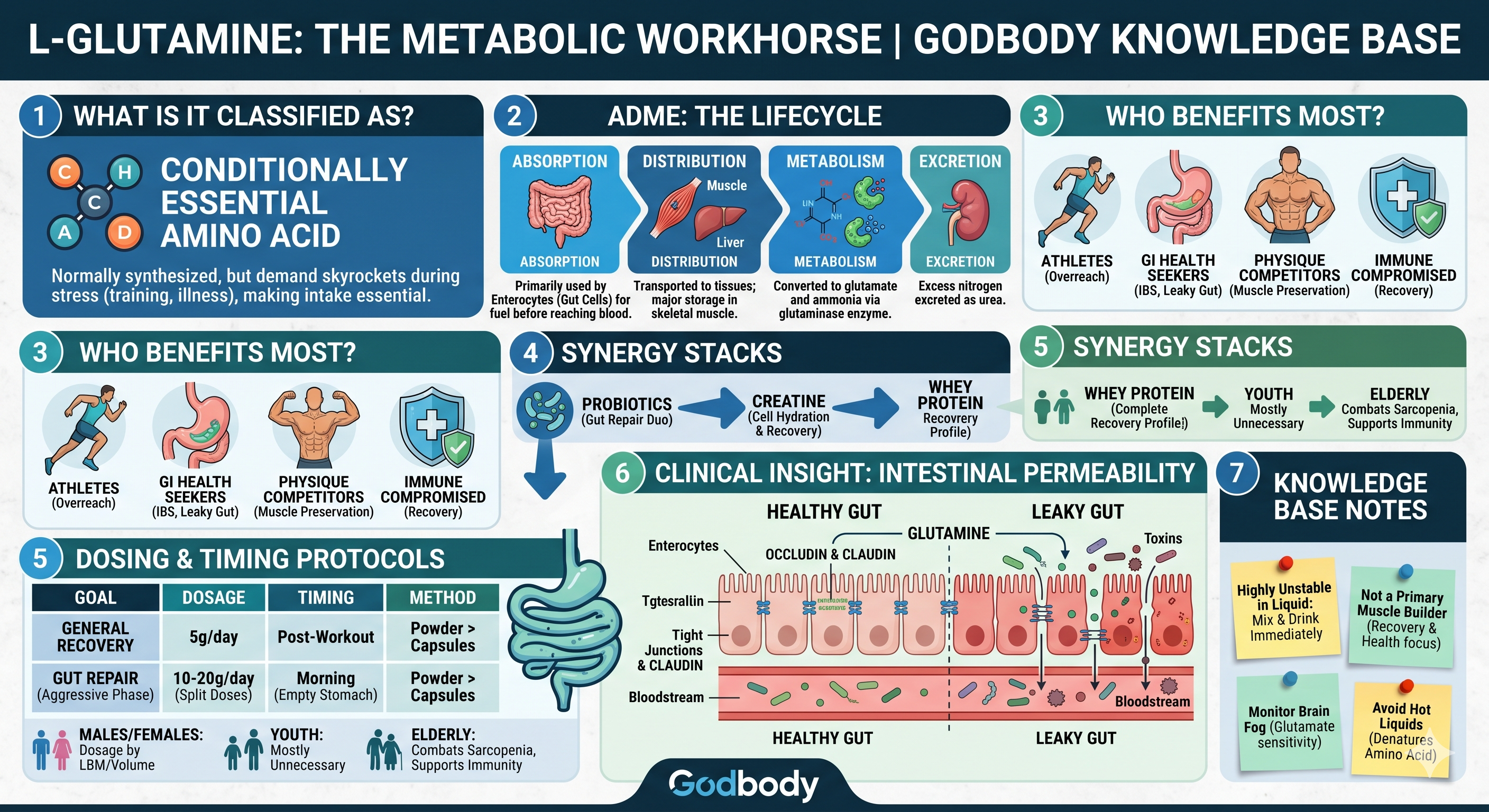
L-Glutamine is the most abundant amino acid in the human body. While often overshadowed by Branched-Chain Amino Acids (BCAAs) in sports nutrition, its role in gut integrity, immune function, and nitrogen transport makes it a foundational tool for both performance and general wellness.
Classification
Glutamine is classified as a conditionally essential amino acid.
- The Nuance: Under normal conditions, your body can synthesize enough on its own (non-essential). However, during periods of high physiological stress—such as intense training, trauma, or illness—the demand outstrips the body’s ability to produce it, making dietary or supplemental intake “essential.”
ADME: The Life Cycle of Glutamine
- Absorption: Primarily absorbed in the small intestine via sodium-dependent transport systems. It is unique because the cells of the small intestine (enterocytes) use glutamine as their primary fuel source before it even reaches the rest of the body.
- Distribution: Once in the bloodstream, it is distributed to the liver, kidneys, and skeletal muscle. Skeletal muscle serves as the primary storage site, containing about 75–80% of the body’s glutamine.
- Metabolism: It is metabolized into glutamate and ammonia by the enzyme glutaminase. It plays a critical role in the “Glutamine-Glutamate Cycle,” which is vital for neurotransmitter balance.
- Excretion: Excess nitrogen from glutamine metabolism is primarily excreted as urea via the kidneys.
Who Would Benefit?
- Athletes in Overreach: Those training with high volume/intensity who need to prevent “Overtraining Syndrome.”
- GI Health Seekers: Individuals dealing with “leaky gut” or IBS, as it helps repair the intestinal lining.
- Physique Competitors: Those in a deep calorie deficit who need to preserve lean muscle mass and manage ammonia buildup.
- Immune-Compromised: People recovering from surgery or chronic illness.
Synergy with Other Supplements
- Probiotics: Glutamine provides the “structural repair” while probiotics manage the “bacterial environment,” making them a powerhouse duo for gut health.
- Creatine: Combining the two can enhance cellular hydration and recovery.
- Whey Protein: Since whey is naturally high in BCAAs, adding glutamine creates a more complete amino acid profile for post-workout recovery.
- N-Acetyl Cysteine (NAC): Together, they support the production of Glutathione, the body’s master antioxidant.
Dosing & Timing
| Metric | Recommendation |
| Standard Dose | 5g to 20g per day. |
| Timing (Performance) | Post-workout to replenish intramuscular stores. |
| Timing (Digestive) | First thing in the morning on an empty stomach. |
| Method | Powder is preferred over capsules for higher dosing accuracy and cost-effectiveness. |
Gender & Life Stages
- Males vs. Females: There is no significant difference in how the sexes process glutamine. Dosing should be scaled based on lean body mass and total training volume rather than gender.
- Youth: Generally unnecessary for healthy, active children eating a high-protein diet unless managing specific GI issues under medical supervision.
- Elderly: Highly beneficial for combating Sarcopenia (age-related muscle loss) and supporting a weakening immune system.
Notes
Note 1: Glutamine is highly unstable in liquid. Do not mix it into a shake and let it sit for hours; consume it immediately after mixing.
Note 2: While it is an amino acid, it does not stimulate Muscle Protein Synthesis (MPS) as robustly as Leucine. Think of it as a recovery and health supplement, not a primary muscle-builder.
Note 3: Monitor for “brain fog” in rare cases. Because glutamine can convert to glutamate (an excitatory neurotransmitter), individuals sensitive to glutamate should start with a low dose.
Clinical Insight: Intestinal Permeability & The “Leaky Gut” Mechanism
In the context of high-performance coaching, gut health is the bottleneck for nutrient absorption. Glutamine is the primary metabolic fuel for enterocytes (cells in the small intestine) and is essential for maintaining the Tight Junctions between these cells.
The Mechanism of Action
When the gut is stressed—by high-intensity exercise, NSAID use, or poor diet—the tight junctions loosen. This allows undigested food particles, toxins, and bacteria to enter the bloodstream, triggering systemic inflammation.
- Tight Junction Regulation: Glutamine modulates the expression of proteins like occludin and claudin-1. These act as the “mortar” between the “bricks” (enterocytes) of the intestinal wall.
- Heat Shock Proteins (HSPs): Glutamine induces HSPs that protect cells from thermal stress, which is particularly relevant for athletes training in high-heat environments or performing high-intensity intervals.
Clinical Application for Athletes
Research indicates that intense exercise can reduce plasma glutamine levels by 50%. When these levels drop, the gut becomes compromised, often leading to “Runner’s Trots” or general GI distress during a training cycle. Supplementing with glutamine prevents this permeability, ensuring that the inflammatory response to training remains localized to the muscle rather than becoming systemic.
Updated Dosing for Gut Repair
While a maintenance dose is 5g, clinical protocols for repairing damaged intestinal lining often require higher “loading” phases:
- Aggressive Repair Phase: 0.25g to 0.5g per kg of body weight for 10–14 days.
- The “God Body” Protocol: Start with 5g twice daily (fasted morning and before bed). If GI distress persists, scale to 10g per serving.
Clinical Note 4: If someone has a history of high-grade ammonia sensitivity or certain liver pathologies, high-dose glutamine should be approached with caution, as it is a major carrier of nitrogen.
Clinical Note 5: For maximum efficacy in gut repair, avoid taking glutamine with very hot liquids, as high temperatures can denature the amino acid and reduce its biological activity.