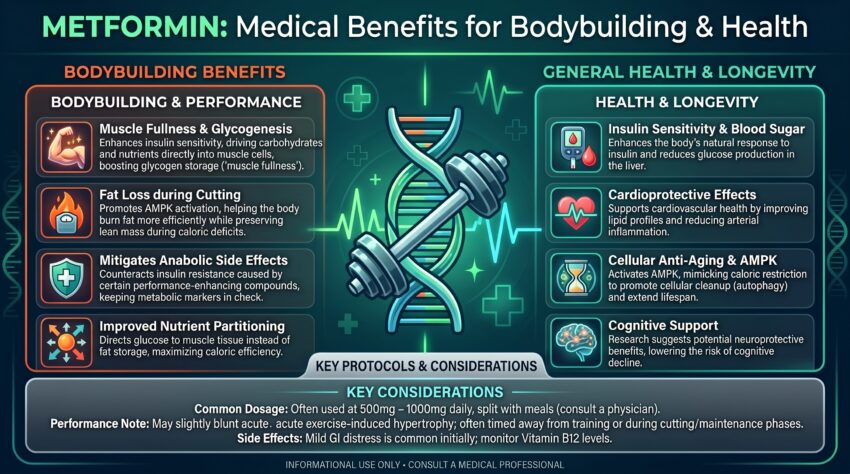
Classification: Biguanide Anti-Hyperglycemic Agent / Insulin Sensitizer (Non-Peptide Oral Compound)
Metformin Application: Bodybuilding vs. General Health
| Feature | Bodybuilding & Athletic Performance | General Public & Metabolic Health |
| Primary Goal | Nutrient partitioning (shunting carbs to muscle, not fat) | Reversing insulin resistance, lowering HbA1c & fasting glucose |
| Secondary Goal | Mitigating GH/Secretagogue-induced insulin resistance | Weight management, visceral fat loss, and appetite regulation |
| Target Pathway | Muscle GLUT4 translocation & mitochondrial efficiency | Hepatic gluconeogenesis inhibition & gut GLP-1 stimulation |
| Dosing Strategy | Post-workout / High-carb meal timing (500mg–1000mg) | Titrated daily dosing with meals (500mg–2000mg ER) |
| Key Synergy | Berberine/ALA, Vitamin B12, High-protein/High-carb meals | B12, GLP-1 Agonists, Inositols, Caloric Deficit |
| Microbiome Effect | Enhances nutrient extraction & gut barrier integrity | Increases Akkermansia, SCFAs, and satiety signals |
ADME Profile (Absorption, Distribution, Metabolism, Excretion)
- Absorption: Incompletely absorbed from the small intestine (bioavailability approx. 50–60%). Food slightly delays absorption but improves gastrointestinal tolerance.
- Distribution: Rapidly distributes into body tissues (liver, kidneys, gut wall, erythrocytes). Does not bind to plasma proteins (unbound state).
- Metabolism: Not metabolized by the liver. It undergoes no cytochrome P450 hepatic transformation and circulates strictly as unchanged parent compound.
- Excretion: Excreted unchanged via renal tubular secretion (90%+ cleared within 24 hours in individuals with healthy renal function).
Quick Reference Guide
- Mechanism / Pathways:
- Mitochondrial Complex I Inhibition: Mildly inhibits mitochondrial respiration chain Complex I in hepatocytes, altering the cellular AMP/ATP ratio.
- AMPK Activation: Activates 5′-AMP-activated protein kinase (AMPK), suppressing hepatic gluconeogenesis (glucose output) and upgrading peripheral insulin sensitivity.
- GLUT4 Translocation: Promotes GLUT4 glucose transporter movement to skeletal muscle cell membranes, driving glucose uptake directly into muscle tissue.
- mTOR Crosstalk: Downregulates excessive nutrient/mTORC1 hyper-activation in hyperinsulinemic environments (anti-aging & anti-proliferative mechanism).
- Genomic vs. Non-Genomic: Dual Action.
- Non-Genomic: Immediate acute inhibition of hepatic glucose production, allosteric AMPK activation, and gut GLP-1 secretion.
- Genomic: Downstream suppression of lipogenic and gluconeogenic transcription factors (e.g., SREBP-1c, ChREBP, FOXO1), altering gene expression for long-term metabolic flexibility.
- Key Benefits:
- Nutrient Partitioning: Directs carbohydrates into muscle glycogen storage rather than adipose (fat) storage.
- Visceral Fat Reduction: Lowers circulating fasting insulin levels, unlocking fat oxidation.
- Cardiometabolic & Longevity Support: Improves endothelial function, lowers systemic inflammation, and lowers cardiovascular risk markers.
- Anti-Aging / Cellular Autophagy: AMPK activation mimics caloric restriction pathways.
- Dosing Range:
- Starting Dose: 500 mg once daily with a heavy meal to evaluate GI tolerance.
- Standard Effective Range: 500 mg – 2,000 mg daily (split into 2 doses with meals; Extended Release / ER formulations are strongly preferred).
- Dosing Strategies:
- Bodybuilding Protocol: 500 mg – 1,000 mg taken with the largest high-carbohydrate meals of the day (e.g., post-workout meal #2 or high-carb off-season meals) to drive muscle glycogen storage while avoiding immediate peri-workout mTOR blunting.
- General Health / Fat Loss Protocol: 500 mg ER daily with dinner for week 1, titrating up by 500 mg weekly to 1,000 mg – 2,000 mg ER split between breakfast and dinner.
- Half-Life:
- Plasma Half-Life: ~4.0 to 6.5 hours (Immediate Release).
- Terminal Tissue Half-Life: Up to ~17.6 hours (accumulates transiently in red blood cells and intestinal wall).
- Peak Saturation: Reaches peak plasma concentration (Cmax) in 2–3 hours (Immediate Release) or 4–8 hours (Extended Release/ER). Steady state is achieved within 24–48 hours.
- Duration of Use: Continuous/long-term therapy for metabolic wellness, or cycled during heavy bulking phases/high-carbohydrate off-season training blocks.
- Detectability: Not listed on the WADA prohibited list (non-hormonal, non-anabolic, non-stimulant).
Dual Application Deep-Dive
1. Bodybuilding & Athletic Performance
- Carbohydrate Disposal Agent (GDA): Ensures that massive off-season calorie surpluses are stored as muscle glycogen rather than subcutaneous or visceral fat.
- Growth Hormone / Secretagogue Countermeasure: Exogenous GH or GHRPs elevate blood glucose and induce hepatic insulin resistance. Metformin neutralizes this side effect, preserving pancreatic beta-cell health.
- Vascularity & Muscle Fullness: By maximizing skeletal muscle GLUT4 expression and intramuscular glycogen storage, muscle bellies appear fuller and tighter.
- Timing Consideration: Because AMPK activation can acutely attenuate acute mTOR signaling immediately following weight training, bodybuilders should avoid taking Metformin in the immediate pre/post-workout window (within 1–2 hours of lifting) and instead take it with later high-carb meals.
2. General Public & Out-of-Shape Individuals
- Reversing Insulin Resistance: Restores tissue sensitivity to insulin, curbing baseline hyperinsulinemia and reducing the risk of Progression to Type 2 Diabetes.
- Visceral Adiposity Loss: Targets deep abdominal visceral fat surrounding organs, which is the most metabolically active and dangerous fat depot.
- Satiety & Craving Reduction: Delays gastric emptying and increases circulating satiety peptides (GLP-1 and PYY), lessening compulsive overeating and carb cravings.
- Lipid Profile Optimization: Helps lower LDL cholesterol, triglycerides, and systemic markers of inflammation (hs-CRP).
Gut Health & Microbiome Impact
Metformin’s beneficial effects extend far beyond glucose regulation; it acts as a microbiome remodeler:
- Expansion of Akkermansia muciniphila: Metformin selectively stimulates the growth of Akkermansia muciniphila, a crucial bacterium that degrades mucin to strengthen the intestinal mucosal lining, preventing “leaky gut” and systemic endotoxemia.
- Short-Chain Fatty Acid (SCFA) Production: Increases populations of Bifidobacterium and other SCFA-producing microbes, elevating butyrate and acetate levels. SCFAs improve colonocyte health and suppress inflammatory cascades.
- Endogenous GLP-1 Secretion: By altering intestinal bile acid reabsorption and gut luminal glucose transit, Metformin triggers L-cells in the distal gut to secrete endogenous GLP-1 (Glucagon-Like Peptide-1), promoting natural appetite regulation.
Safety, Side Effects & Contraindications
Side Effects
- Gastrointestinal Distress (Most Common): Bloating, abdominal cramping, loose stools/diarrhea, nausea, and metallic taste. Prevention: Use Extended Release (ER/XR) versions, start at 500 mg, and take strictly with whole-food meals.
- Vitamin B12 Depletion: Long-term Metformin use inhibits calcium-dependent B12-intrinsic factor membrane complex absorption in the terminal ileum. B12 supplementation is mandatory.
- Lactic Acidosis (Extremely Rare): Occurs almost exclusively in patients with severe underlying organ failure (renal impairment or tissue hypoxia).
Contraindications
- Severe Renal Impairment: eGFR < 30 mL/min/1.73 m2 (due to decreased renal clearance leading to drug accumulation).
- Acute Metabolic Acidosis / DKA.
- Severe Hepatic Impairment / Active Liver Failure.
- Acute Heart Failure or Hypoxic States.
- Chronic Heavy Alcohol Abuse.
Synergies & What to Avoid
Synergy Supplements
- Vitamin B12 (Methylcobalamin) / B-Complex: Essential baseline supplement to prevent Metformin-induced B12 deficiency and peripheral neuropathy.
- Berberine / Dihydroberberine: Synergistic AMPK activator; pairing allows for lower Metformin dosages while maintaining optimal GLUT4 activation.
- Alpha-Lipoic Acid (R-ALA): Amplifies insulin receptor sensitivity and glucose disposal into muscle cells.
- CoQ10 (Coenzyme Q10): Protects mitochondrial energetics and offsets mild mitochondrial Complex I inhibition.
- GLP-1 Agonists / Inositols: Potent combination for severe insulin resistance and obesity management.
What to Avoid
- Heavy Alcohol Consumption: Alcohol enhances Metformin’s effect on lactate metabolism, significantly elevating lactic acidosis risk.
- Iodinated Radiocontrast Dyes: Metformin should be temporarily paused prior to and 48 hours after procedures involving intravascular contrast to protect kidney function.
- Immediate Pre-Workout Window: Avoid taking standard-release Metformin right before heavy strength/hypertrophy training to prevent blunting acute peri-workout mTOR activation.
- Severe Dehydration / Starvation Diets: Dehydration impairs renal clearance and increases metabolic stress.
General Coaching Notes
Metformin is one of the most thoroughly researched, cost-effective, and versatile compounds in metabolic medicine and modern athletic coaching. Rather than acting as a traditional “fat burner” or central nervous system stimulant, Metformin acts as a metabolic governor. It optimizes how the body handles every single gram of carbohydrate consumed.
For the general public or out-of-shape clients struggling with weight loss, baseline hyperinsulinemia acts like a metabolic lock, keeping fatty acids trapped inside fat cells. Metformin lowers baseline insulin levels and restores systemic sensitivity, effectively unlocking stored body fat to be burned as energy while healing the gut lining and quietly reducing appetite.
For bodybuilders and athletes, Metformin serves as the ultimate insurance policy during high-calorie off-season growth phases. Massive food intake, high carbohydrate diets, and exogenous growth hormone usage inevitably lead to insulin resistance. By keeping muscle tissues sensitive to insulin, Metformin ensures that incoming surplus calories are channeled toward glycogen replenishment and muscular repair rather than unwanted fat gain.
When introducing Metformin to a client’s regime, gut comfort and gradual titration are key. Always opt for Extended Release (ER) formulations, prescribe taking it mid-meal, enforce daily Vitamin B12 supplementation, and time doses around high-carbohydrate meals away from the immediate peri-workout window for optimal results.